
Notes ai-security
Memory Accounting: Appendix
Contents
1 Protocol
1.1 Foundations of the protocol
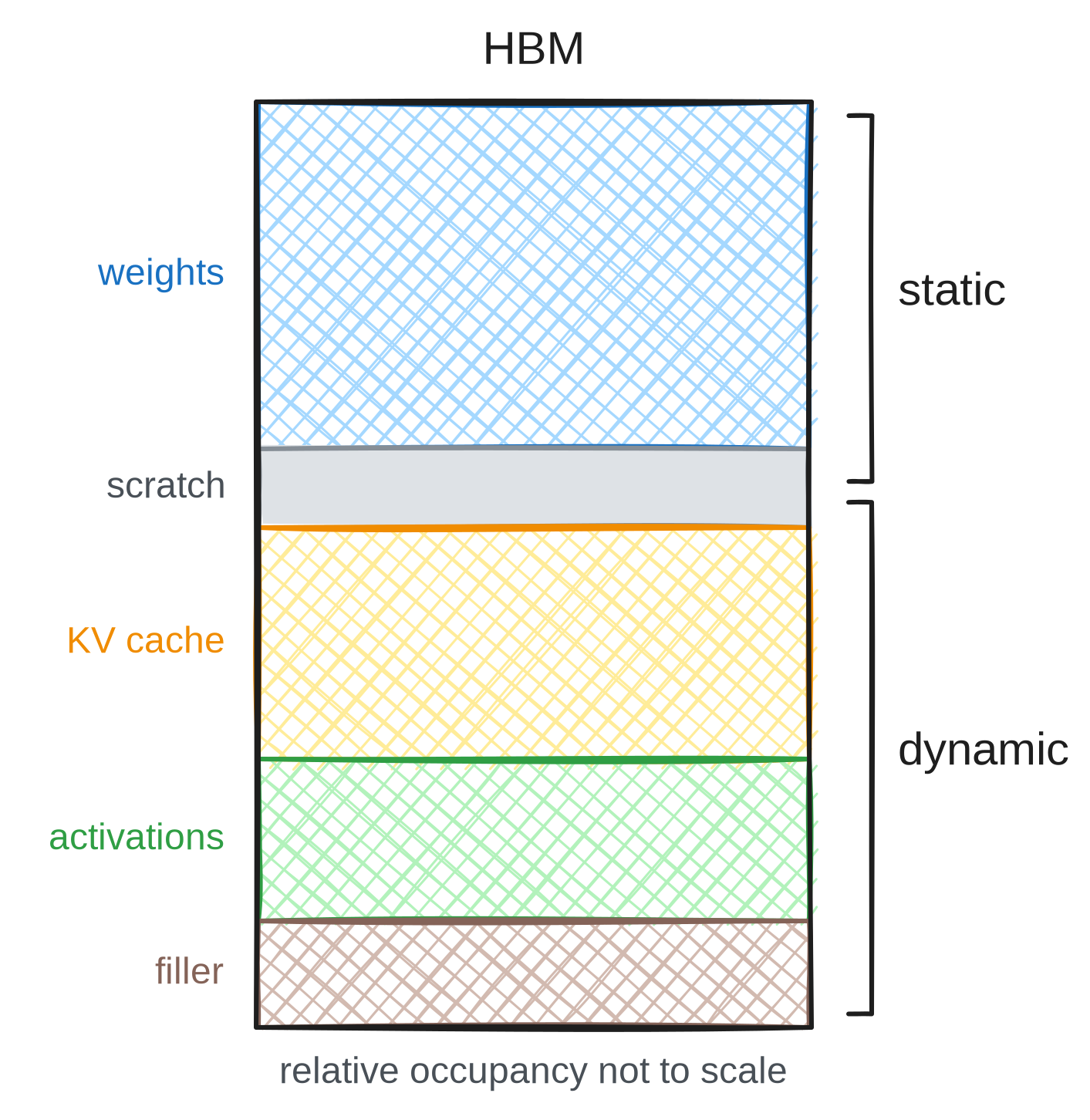
The system splits a GPU’s memory into two regions: static and dynamic.
Static memory is any memory that does not change during inference. In the protocol, this is the model weights and any pseudo-random filler data used to verify memory declared as empty.
Dynamic memory is memory that updates during inference: KV cache, activations, and scratch. Dynamic memory also contains dynamic filler, which is used to verify empty dynamic memory when the KV cache doesn’t saturate the dynamic memory region.
The system uses timed challenges to verify that something really is in HBM. The key mechanisms are:
-
A GPU can perform matmuls with data from HBM faster than on data held anywhere else (DRAM, another GPU, SSD etc.)
-
By timing challenges, a verifier can be confident that the challenge results really do come from HBM
-
A chain of sequential matmuls and hashes makes it easier to distinguish between a cheater and jitter.
1.2 Protocol overview
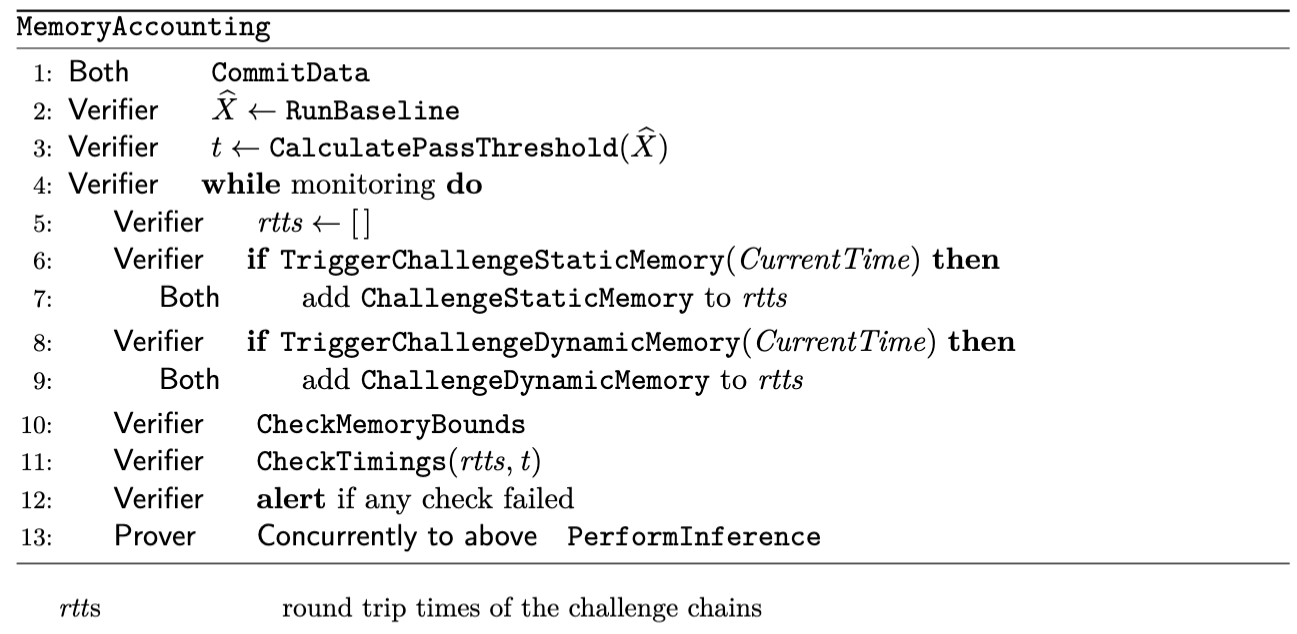
In the setup phase the prover fills the HBM with an encoding of the weights and a reproducible filler to fill up the remaining memory. The verifier runs a baseline for how long it takes for an honest prover to respond to a challenge. This baseline is used later to assess whether memory challenges are passing or failing.
An honest prover is serving inference on a declared model. The prover serves inference, running until the verifier sends a challenge.
The verifier decides both when the challenge happens and whether it is a static memory region challenge or a dynamic memory region challenge.
The prover answers the challenge. The verifier:
-
times how long it takes for the prover to respond to the challenge, and
-
checks whether the challenge answer is correct.
The prover then resumes inference from the layer boundary it stopped at.
The verifier raises a flag if the mean response times are significantly longer than those from the trusted baseline.
1.3 Setup phase
1.3.1 CommitData
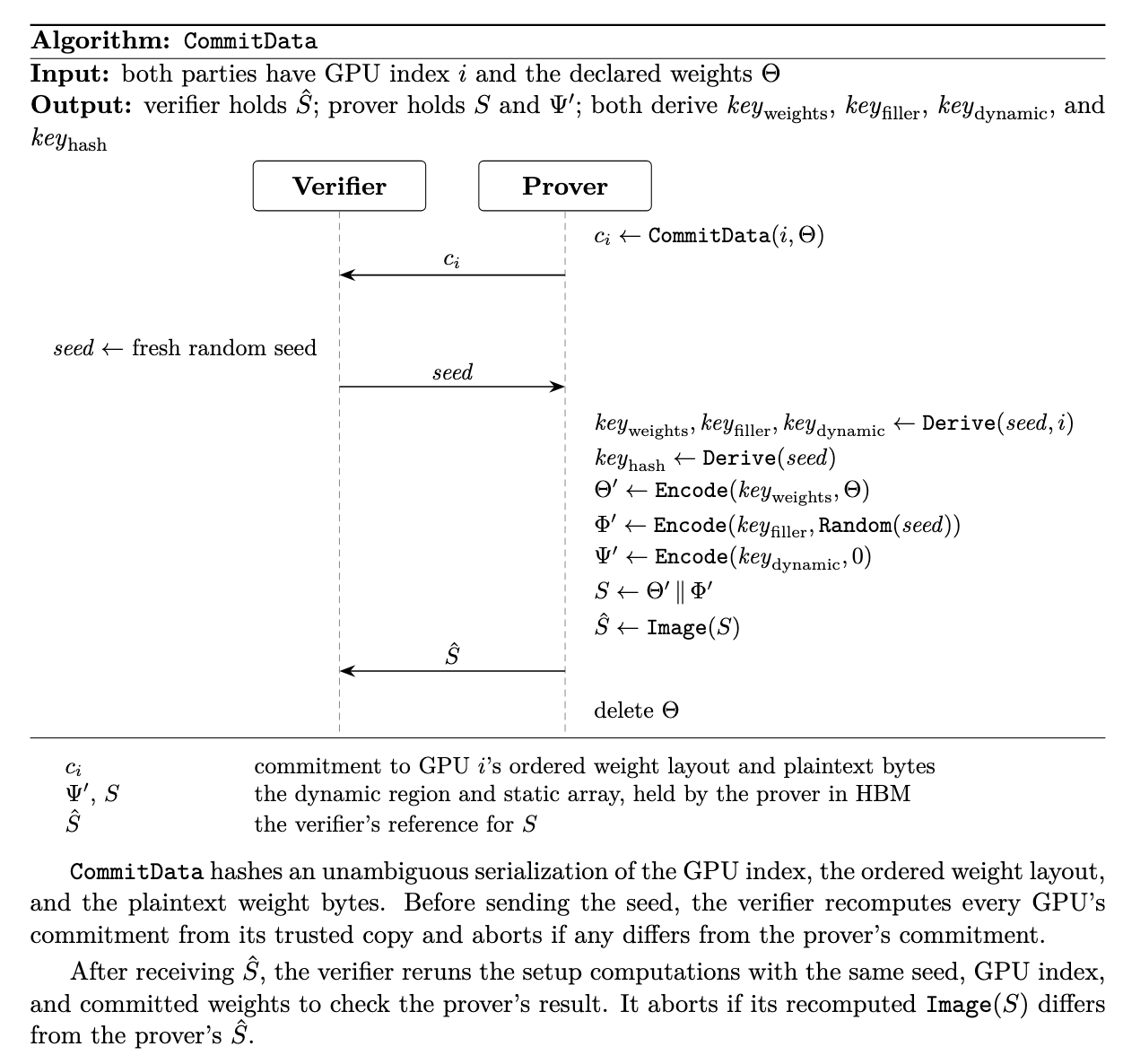
Goal: Provide the verifier with a commitment of the contents of memory. The challenges use these to check the correctness of the challenge response.
Generating the seed and keys. The verifier chooses a random seed and sends this to the prover.1 From the seed, the prover derives the keys for encoding the weights, dynamic region and filler. These keys also depend on the GPU’s index i, so each GPU holds different data, and one cannot answer for another. keyhash is also generated in CommitData and used in the challenge phase. Because the seed is the verifier’s and is new at every setup, the prover cannot prepare any of this data beforehand.
The committed data is in an incompressible encoding. If the contents can be compressed the prover can store other data at the same time as their committed data. Decode is sufficiently quick for the committed data to be decoded on the fly during inference. Encode is sufficiently slow such that data cannot be encoded on the fly in response to a challenge. Encode is still fast enough to encode dynamic data required for inference on the fly.
Filling the memory. The encoded weights () don’t fill all of the HBM. The remaining memory capacity is therefore filled with a filler (). is pseudorandom data generated from the seed and encoded with keyfiller. The purpose of the filler is to allow the verifier to challenge “empty” memory to verify that it is not being used to store covert data. and together form the static region , which the prover is not allowed to change after setup. The dynamic region is the working memory allocated for inference during runtime, and when empty, it is set to the encoding of zeros under .
Deriving a reference for the verifier. The verifier has to check whether challenge responses about the prover’s weights are correct without knowing the weights. Therefore, the prover sends the verifier a one-way image Image() in place of . Image() is also the same size as . This is a critical requirement. If the verifier’s reference of the weights was smaller than the raw data, a cheating prover could keep just the smaller reference in memory and still answer every challenge correctly. The verifier’s reference for the whole static array is Image() followed by the image of the filler.
After setup. The prover deletes the plaintext weights and serves inference from and (Algorithm PerformInference). From this point onwards, the weights reside in HBM only in encoded form.
Verifying the commitments. The verifier needs to check that the keys, incompressible encoding, and image were generated correctly. In our proof of concept, the verifier does this by recomputing CommitData with plaintext values of the weights.
Future work: replace the recomputation with a zero-knowledge proof.
1.3.2 RunBaseline
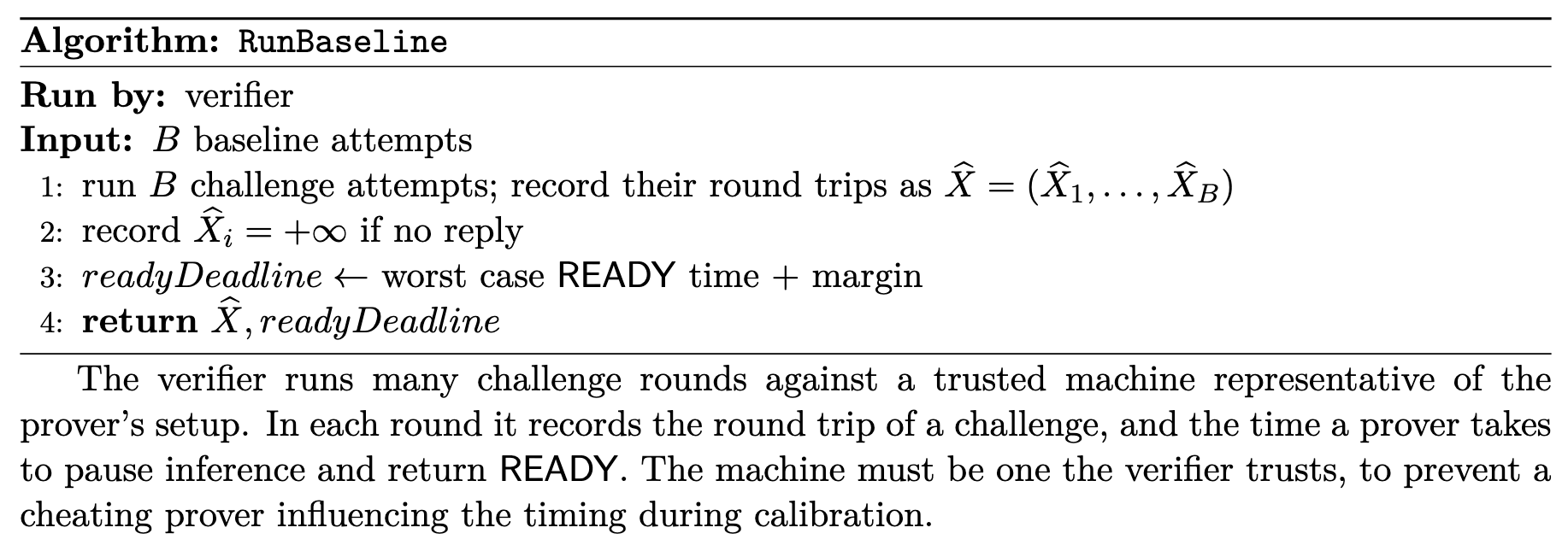
Goal: Provide the verifier with trusted round trip times. CheckTimings compares them to the prover’s round trip times.
The verifier judges an honest versus cheating prover by the timing of a challenge. Therefore, it needs a trusted baseline of how long an honest prover takes to complete a challenge. This procedure measures this, once.
The verifier runs a set of challenge rounds against a trusted machine representative of the prover’s setup. In each round it records the round trip of a challenge, and the time a prover takes to pause inference and return READY. The machine must be one the verifier trusts, to prevent a cheating prover influencing the timing during calibration.
Future work: investigate with what confidence a verifier can establish a trusted baseline. See Open question 1 in Section 5 for a discussion of our observed variance in the baseline.
1.3.3 CalculatePassThreshold
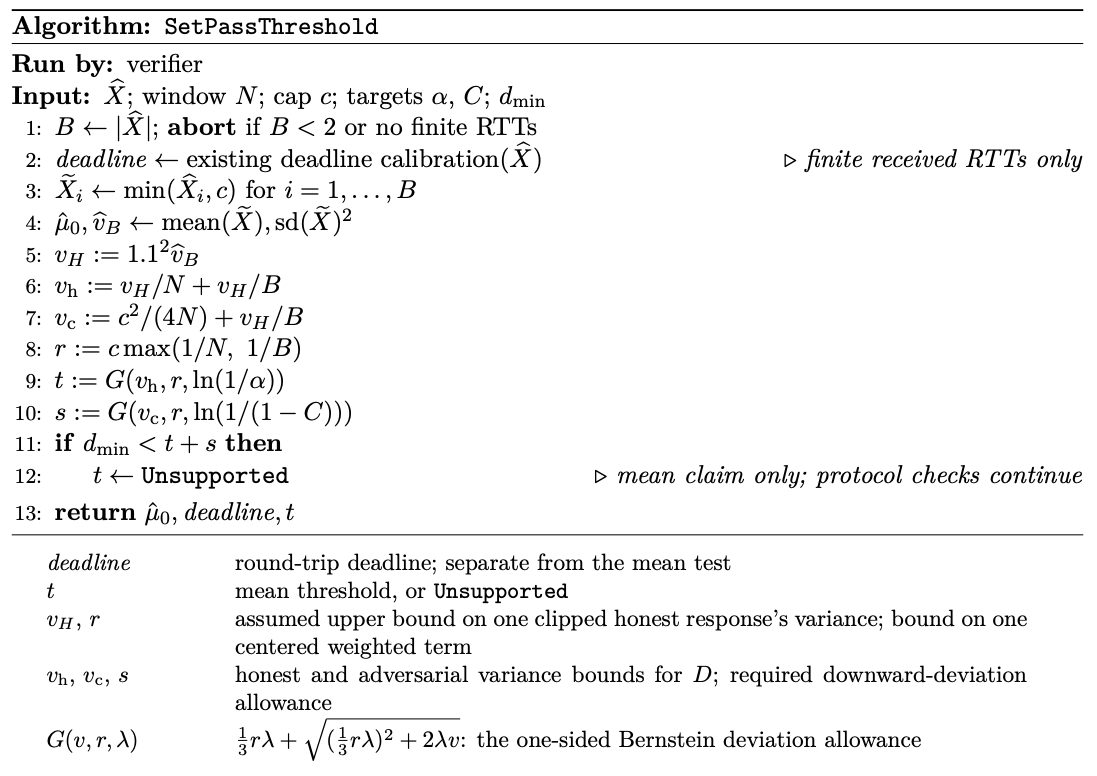
Goal: Provide the mean response time threshold above which CheckTimings should flag cheats.
The mean-test threshold t is selected from the clipped honest baseline for the target false-positive probability α. CalculatePassThreshold checks whether the requested detection probability C is supported for the selected window size N, clipping cap c, and minimum clipped-mean increase dmin. If not, it returns t = Unsupported; the separate protocol checks continue. For the statistical analysis, see CalculatePassThreshold in Section 3.
1.3.4 Encode
Goal: Prevent encoded data from being compressed. Encoded in CommitData, encoded and decoded in PerformInference.
The prover can store uncommitted data if the committed is compressed. We therefore encode the committed data in the incompressible encoding. Decode is sufficiently quick for the committed data to be decoded on the fly during inference. Encode is sufficiently slow such that data cannot be encoded on the fly in response to a challenge. Encode is still fast enough to encode dynamic data required for inference on the fly.
We use a modified version of Fisch’s Basic-VDE-PoRep (original construction). Decode and encode in Basic-VDE-PoRep are too slow for memory accounting. We add some additional assumptions in our modification which allow us to have a shorter deadline for each link:
-
The verifier is physically close to the prover
-
The hash chains let us distinguish between an honest and adversarial response while the time required to complete one link is short.
We make the following changes to Basic-VDE-PoRep, each of which is enabled by our shorter deadline per link.
| Fisch | Modification | |
|---|---|---|
| Field size | 4096 bits | 89 bits |
| Rounds of Sloth | ~23,600 | 1 |
| Blocks | Blocks are m-bit field elements (512 bytes) | Challenges in 1 MiB units, each 128-byte row holds eleven 90-bit values, for encode / decode parallelism. |
Each 128-byte row holds 121 bytes of data in eleven 90-bit values (an 89-bit root and a 1-bit flag). 34 bits of each row are always zero and are left unaccounted.2 We suggest a potentially faster incompressible encoding in the appendix.
Encode and decode
- Split each 121-byte payload into eleven 88-bit values. Derive a separate tweak for each position under the GPU key.
- Add the tweak in the field and apply one round of Sloth. Store each 89-bit root with its sign flag. The eleven 90-bit values occupy a 128-byte row with 34 fixed zero bits.
- To decode, square the root, apply the flag and subtract the tweak. The static verifier image hashes each 32-byte group together with its position.
Future work: Determine which GPUs need to be challenged in parallel. GPUs often have a high-bandwidth connection over the backend network. This can be used to perform Encode in parallel across GPUs once one of them is challenged. One solution is to send a challenge at the same time to all the GPUs that can effectively assist each other.
1.4 Running inference during challenges
Goal: Serve inference efficiently with encoded data in HBM.
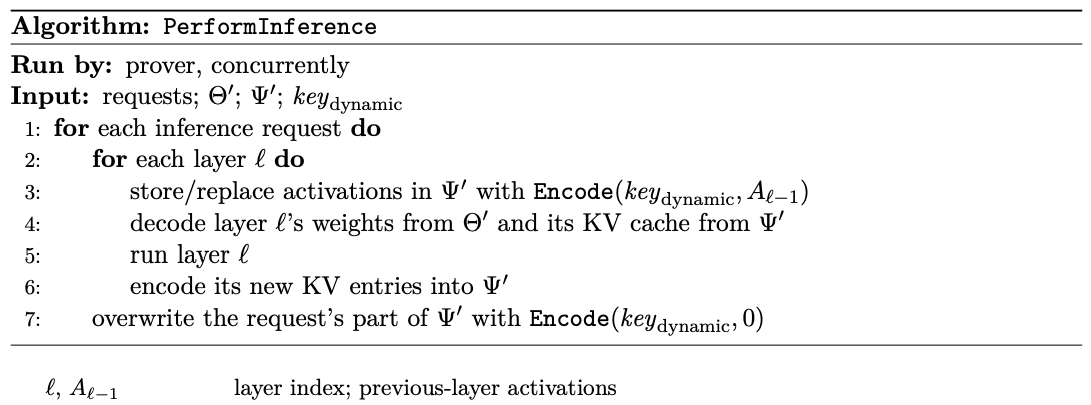
Inference has to run from encoded memory because the prover cannot store the plaintext weights in HBM. The KV cache and activations are also encoded. Algorithm PerformInference shows how inference can proceed while keeping plaintext only in scratch.
The activations and KV cache in HBM are encoded. The layer’s weights are decoded from , and its KV cache from , into scratch. The inference layer runs using this plaintext, and the new KV entries it produces are encoded back into . Plaintext exists only in scratch, for one layer at a time.
Future work: keep plaintext data only in cache and registers rather than scratch.
1.5 Challenge phase
The verifier times the prover’s response time to a challenge. Challenges are sent at random intervals. They are designed to be slow to respond to if the prover didn’t have the committed data in memory when the challenge was received. CheckTimings will later raise an alert if the mean response time is above the threshold.
The verifier initiates a challenge with a message containing a random starting memory location, and a fresh random number . The prover answers with a digest that it computes from random blocks of one of its regions. The verifier times the answer and compares it with the digest it computes from the setup commitment. This section gives the core computation (the chain), the two kinds of round that use it, and the check that follows a dynamic round.
Future work: Combine the static and dynamic challenges into one challenge. This would simplify the statistical analysis and make the system a bit more robust.
1.5.1 Chain
Goal: Return a digest which is slow to generate if the prover doesn’t have the committed data in HBM. Key component of the challenges.
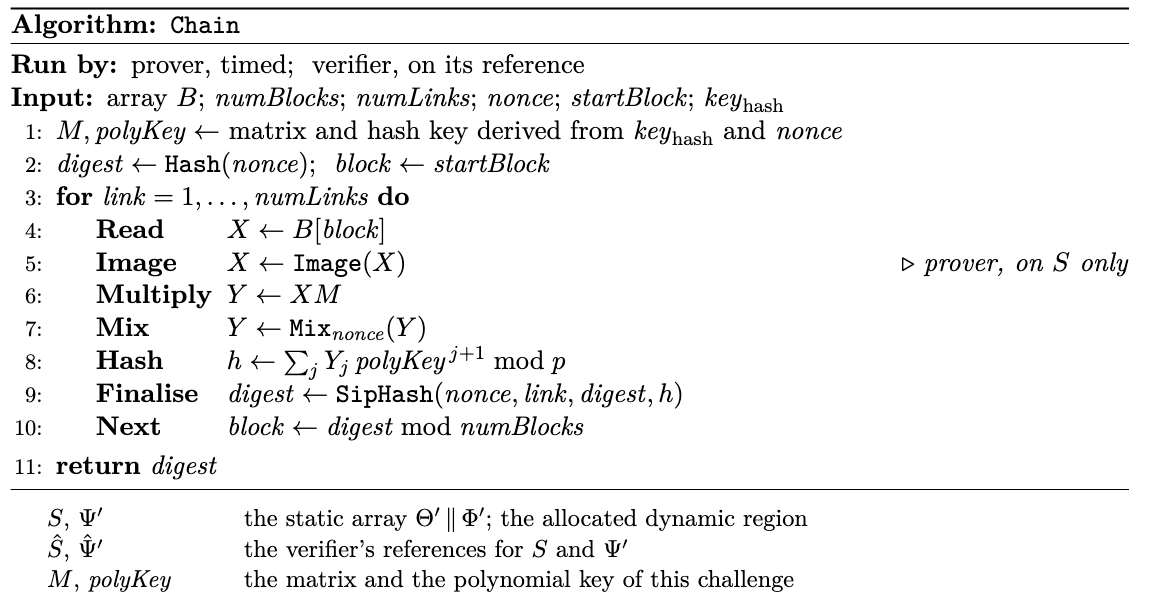
Chain computes the answer to one challenge. The challenge is a nonce and a start block , both fresh and random. The chain has links, and each link does the following.
-
Read one whole block of the array.
-
Image the block for a static challenge. The prover applies Image to its block from S because the verifier holds only the one-way image of the static array.
-
Multiply the block by a matrix M derived from keyhash and nonce. When a block is in HBM a GPU does this significantly faster than a CPU.
-
Mix and hash the result to a single value using polyKey, derived from and the nonce. The key is new for every challenge, so nothing computed for one challenge can be kept and used for another. The mix is non-linear, so the multiply and the hash cannot be merged into one cheaper step.
-
Finalise and Next - The value is combined with the previous digest, and the new digest picks the next block.
The prover cannot know which block comes next until it has finished the current link. The final digest depends on every block read, so no read can be skipped. The blocks therefore have to be read sequentially. Every block that is not in the GPU’s memory adds its own delay to the round trip.
The chain timing difference between an honest and cheating prover is numLinks times larger with numLinks links. This makes it easier to distinguish between cheats and random variation in network delay. The number of links has a ceiling: the time to complete the chain cannot exceed the time it takes for the prover to fill up HBM with data from DRAM.3 After that time, every read is as fast as an honest one.
Future work: Estimate the effect on response time by running two challenges on the same GPU within microseconds of each other. Adjust the protocol accordingly.
The prover runs the chain over its own memory and is timed. The verifier runs the same chain over its reference, to verify the correctness of the digests. The verifier has no time limit.
1.5.2 ChallengeStaticMemory
Goal: Record the round trip time and correctness of the prover calculating Chain over static data.
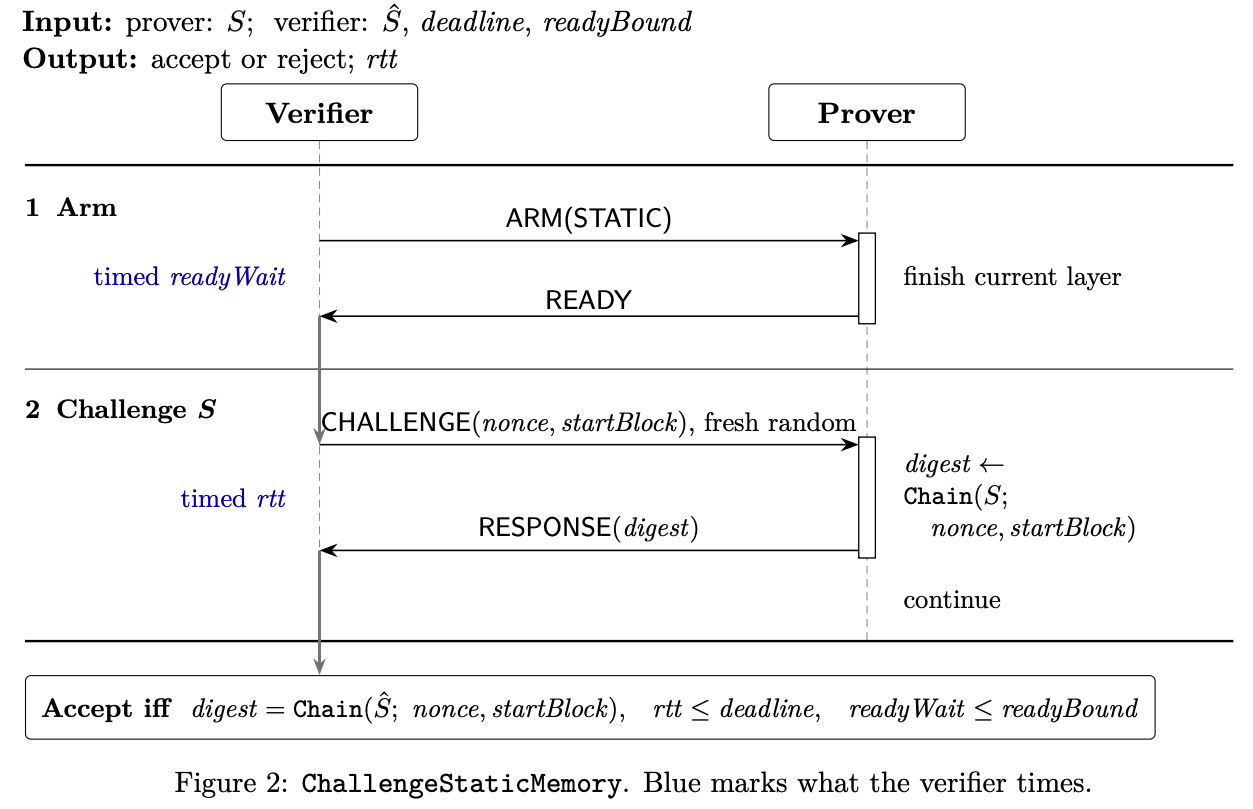
A static memory challenge round (Figure ChallengeStaticMemory) checks the static array : the encoded weights and the filler.
In the first stage, the verifier sends an ARM message to the prover. The prover finishes its current inference layer, pauses inference, and replies READY. The verifier records the time a prover takes to respond READY as . In the second stage, the verifier sends the challenge, the prover runs Chain over and returns the digest , and the verifier times the round trip, . The prover then continues inference.
The round has two stages because the chain must run on an idle GPU. If inference were running, the round trip would vary with the GPU’s load, and could not be compared with the calibrated baseline. The cost of pausing is that the prover receives advanced notice of an incoming challenge, which is why the wait has a bound: it limits how much data a prover could load back into the GPU’s memory in that time.
Future work: Interrupt inference and read the partially corrupted memory contents. Remove the ARM and READY stages.
The verifier accepts if and only if
-
the digest equals the one it computes over its reference , and
-
the round trip is within the deadline , and
-
the wait is within its bound .
1.5.3 ChallengeDynamicMemory
Goal: Record the round trip time and correctness of the prover calculating Chain over dynamic data.
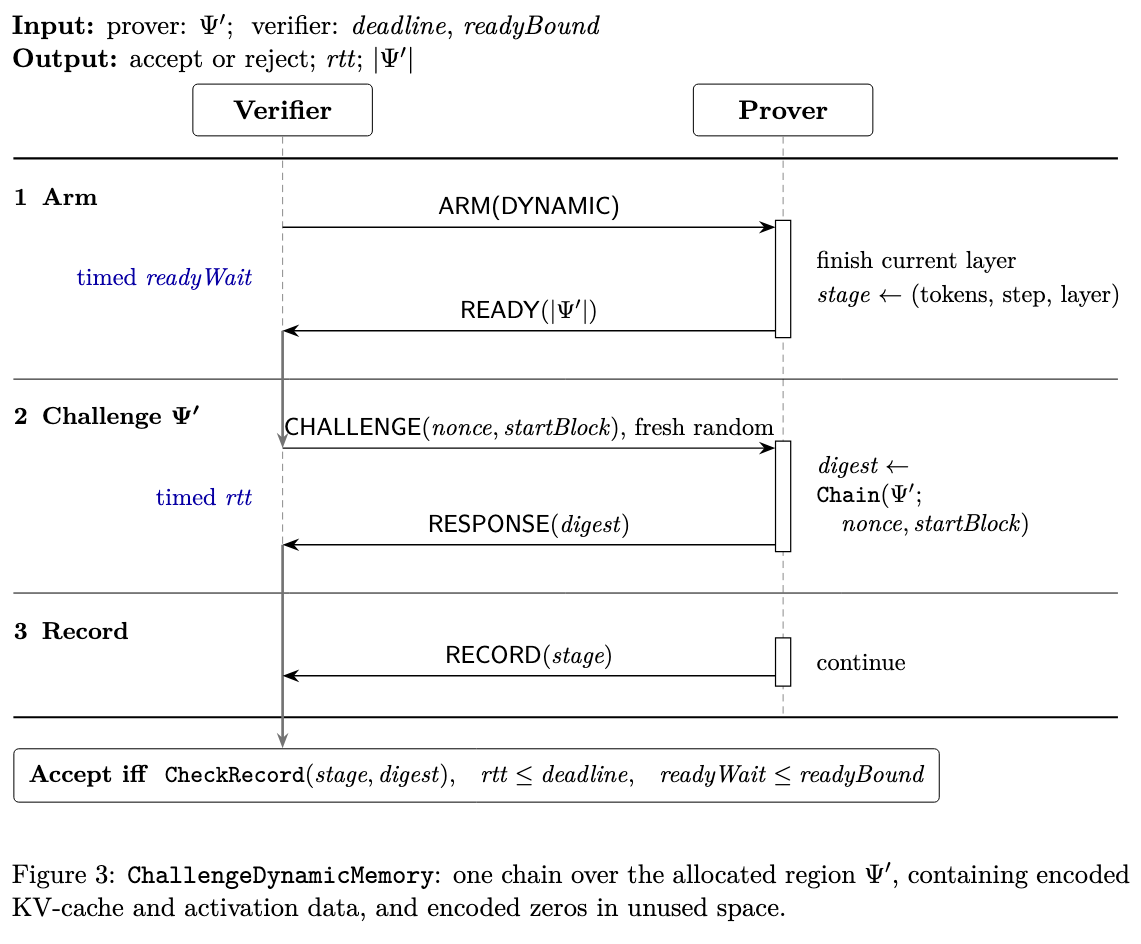
A dynamic memory challenge round (Figure ChallengeDynamicMemory) checks the dynamic region (Ψ′). Ψ′ holds the KV cache and activations, and changes at every step of inference. The verifier cannot hold a reference for in advance, because its contents depend on the inference requests being served. Therefore, the round has two additional stages:
-
the prover declares its stage of inference when stopped, and
-
the verifier later performs a recomputation of .
The round begins like ChallengeStaticMemory. The prover stops inference and reports READY. The prover also reports the size of . The memory claim uses this size (CheckMemoryBounds).
ChallengeDynamicMemory runs one chain over all of . The region contains the encoded KV cache and activations, with encoded zeros in unused space. The chain samples across the entire allocation, and the verifier checks its single returned digest against a recomputation of that allocation.
After returning the challenge response, the prover sends a record of the stage information and resumes inference. This record includes:
-
the input tokens for the current inference request,
-
the step in the token sequence, and
-
the layer it stopped at
The record is sent after the timed READY, so transmitting it does not add to rtt.
The verifier accepts if and only if
-
rtt is within deadline
-
readyWait is within readyBound, and
-
the record passes CheckRecord.
1.6 Checks
CheckRecord and CheckMemoryBounds are called by a challenge to determine whether it passed. CheckTimings is called to check if a set of challenges has a mean response time below the threshold.
1.6.1 CheckRecord
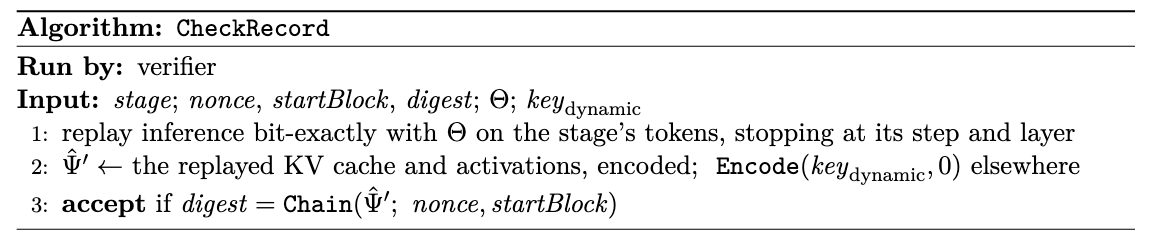
Goal: Check that the digest from the dynamic challenge is correct given the declared input tokens and weights.
CheckRecord computes the expected digest for a dynamic challenge. It runs inference with the weights on the tokens defined by the record. It stops at the same step and layer. This rebuilds what the prover’s dynamic region should have held when it stopped: the KV cache and activations, encoded under , and the encoding of zeros everywhere else.
The verifier accepts if the digest it received equals the digest based on the recomputed reference.
There is no tolerance as the comparison is between digests. The recomputation therefore has to reproduce the prover’s memory bit-exact. That requires deterministic inference. We’ve implemented that with both:
-
vLLM’s deterministic inference mode
-
An integer model
Future work: replace recomputation with a zero-knowledge proof.
1.6.2 CheckMemoryBounds
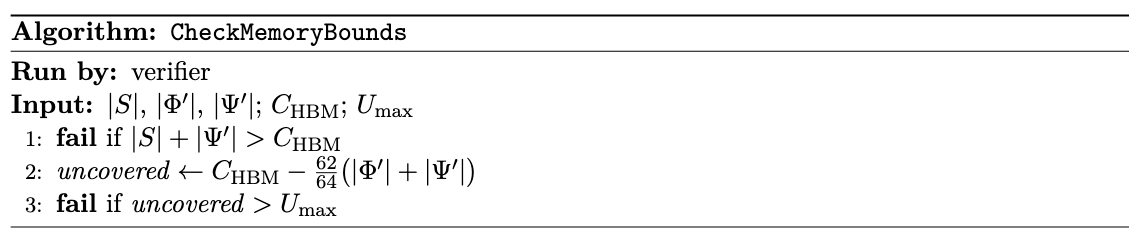
Goal: Alert if the declared memory region sizes are smaller than allowed.
CheckMemoryBounds runs after each dynamic round. That is when the prover reports the size of the dynamic region. The sizes of the static array and the filler come from setup. The size in READY is the prover’s own report, but it gains nothing by overstating them: every block it reports can be picked by a chain, so memory it claims and does not hold fails a challenge.
The verifier rejects if
-
the sizes are contradictory
-
there is more uncovered memory than
- Uncovered memory is the part of the GPU’s capacity that the verifier doesn’t challenge. E.g. we credit encoded memory as being accounted for of their size: 34 bits of every 128-byte row are always zero.
1.6.3 CheckTimings
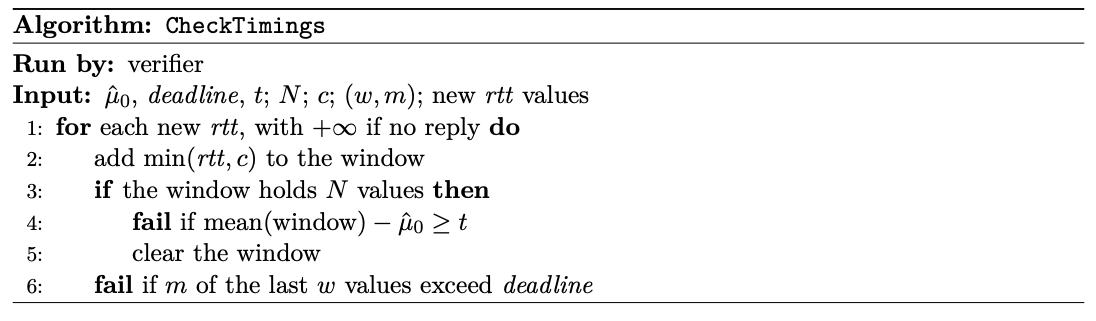
Goal: Alert if the mean response time over the test window is above the threshold.
The deadline catches a response that is clearly late. It does not catch a prover that keeps most of its data in the GPU’s memory and a small share elsewhere: only a few of a chain’s reads are slow, and the round trip stays inside the deadline. Such a prover is still slower on average, and Algorithm CheckTimings observes this over many rounds.
2 Future Work
2.1 Investigate key assumptions
How feasible is it to gain a trusted baseline?
-
The verifier inspecting the prover’s hardware.
-
Installing a direct connection between the prover and verifier: a separate network for memory accounting challenges.
-
Finding ways to increase the difference between an honest and a cheating response time.
-
Controlling for changes in response times during the day
2.2 Speeding up inference
-
Making the decode operation of the incompressible encoding faster. This is currently causing a 4.47× slowdown.
-
Making the encode operation of the incompressible encoding faster. The verifier must still be able to detect an encode operation on demand.
2.3 Making memory accounting confidential
We want to replace each recomputation with zero-knowledge proofs (ZKPs). The prover could then hide the weights, and possibly other confidential data, from the verifier.
2.4 Reducing the amount of unaccounted memory
-
Investigate whether activations and KV cache can be kept encoded in HBM and only be decoded in GPU cache.
-
Add a filler to the 34 fixed zero bits in each 128-byte row of the incompressible encoding.
-
Interrupt inference immediately when a challenge starts, instead of a graceful pause.
-
Verify data that is in scratch memory.
2.5 Verifying DRAM and HBM in parallel
Memory accounting verifies only HBM. The prover can run an undeclared workload from DRAM. We can make stronger guarantees if the fastest unverified memory is SSD rather than DRAM.
2.6 Red-teaming and formalising the security properties of memory accounting
We expect more red-teaming will find some issues with our proof-of-concept.
2.7 Extend to a more complex environment
-
The prover may have multiple racks of GPUs
-
The connection between the prover and verifier might go over many switches
-
Support more complex serving features
-
Model and tensor parallelism
-
Speculative decoding
-
2.8 Other
- Understand how much of an issue response time drift is. This breaks our independence assumption. Potentially most of this issue can be alleviated with an updated statistical analysis. More empirical measurements on more realistic workloads and in more realistic environments would also be useful. [See CalculatePassThreshold]
3 CalculatePassThreshold
Memory accounting aims to verify this claim:
Claim 1: The average fraction of data in HBM that deviates from the declared data over time and number of GPUs, , is at most .
This section is written to describe the statistical test and justify why we chose this statistical approach. This statistical analysis covers only the data that memory accounting covers, it does not include:
-
Scratch
-
The 34 bits in each 128-byte row of the incompressible encoding that are unused
-
The amount of data that can be moved into HBM during the time it takes for the prover to respond “READY”
The naive approach
The naive approach is to extend AI2040’s statistical analysis:
-
Use a cutoff for each challenge to determine whether it failed or succeeded.
-
Use a Poisson distribution to estimate how many challenges are required to gain a reasonable confidence that no more than proportion of the challenges will fail.
However, a single cutoff per challenge can’t reliably detect a partial residency attack. The extra time required for one cheat is smaller than the network jitter. We will therefore analyse the mean response time instead of each challenge one by one.
The Poisson distribution is not well suited for such analysis as it counts binary events. Mann–Whitney could be a useful test, but it does not directly measure the value we care about, the mean response time.
Bernstein’s inequality
Bernstein’s inequality limits the probability that a sum of many independent random values is far from its expected value.
Let be independent random values, and let . Then, for any deviation size :
The inequality needs three assumptions:
-
The values are independent.
-
We know an upper bound on .
-
No value is more than away from .
Our model
Each challenge is a chain of reads. We model its response time as:
Here models the smallest added time from the cheated reads. Before calculating either the baseline or test average, we clip each response time:
The reference time and clipping cap are fixed before collecting the baseline and test samples used below. If the reference is measured, it comes from separate calibration samples. Choosing the cap from the same baseline samples would need a different analysis.
Where
-
: the total response time of challenge .
-
: the time that an honest prover would take for challenge .
-
: the true mean of a clipped honest response time.
-
: our estimate of , the average of clipped honest baseline response times.
-
: the measured sample variance of the clipped honest baseline responses, using denominator .
-
: an assumed upper bound on , the true variance of one clipped honest response; this is distinct from the estimate .
-
-
: the number of cheated reads in the chain, between 0 and .
-
: the smallest possible time added by a cheated read.
-
: the number of challenges in the baseline.
-
: the number of challenges in one test window.
-
: the mean of the clipped response times in the test window.
-
: the fixed cap applied to every baseline and test response time.
-
: the reference time used to choose , fixed separately from the baseline estimate .
-
: the clipping margin above the fixed reference time.
-
: the minimum true increase in the clipped mean that the test is designed to detect.
-
: the threshold; the prover passes if and is flagged otherwise.
-
: the target upper bound on the false positive probability for one test window of challenges.
-
: the target detection probability; is the target upper bound on the false negative probability for one test window of challenges.
-
: number of GPUs.
-
: the time the claim covers.
Our approach
We want to test the following claim:
Claim 2: If the true mean clipped response time exceeds the true honest clipped mean by or more, the test passes with a probability of or less.
To turn Claim 2 into a guarantee about , every prover cheating at level or above must produce a true clipped-mean increase of at least . We express this as . Formalising the relationship between Claim 1 and Claim 2 is further work.
Applying Bernstein’s inequality
Let’s revisit Bernstein’s inequality to:
-
Assess how reasonable the assumptions are in our case
-
Define the variables in our case
The same bound applies to the lower tail.
-
-
.
-
We bound and choose the decision threshold in the section below.
Here is the sum of weighted observations: the clipped test responses divided by , and the clipped baseline responses multiplied by . These are the to which Bernstein’s inequality is applied; consequently bounds each weighted term’s deviation from its own mean, not the range of .
The inequality needs three assumptions.
1. The values are independent
The s are independent as the verifier is sampling uniformly.
Some sources of dependence between challenges are:
-
Contention for resource if two challenges happen close to each other (in time and space)
-
Thermal throttling, load patterns.
Another source of dependence is within challenges:
3. The honest time and cheating addition could depend on each other. For example an adversarial prover who knows they are in a period with a high honest response time could decide to always or never cheat at such times.
For (1) further work is needed to do a more complex timing analysis. For the proof of concept we will list this as an open problem.
For (2) we will assume that this is not an issue, i.e. any load patterns don’t have a significant effect on the response times. A more rigorous approach is an open problem.
For (3) we again assume this is not an issue. This is a reasonable assumption given the assumptions above. If load patterns don’t have a significant effect on honest response times then the verifier won’t have much of an opportunity
One future solution for a more rigorous approach is to assume that the mean response time for a set of consecutive samples are independent of other sets.
2. We know an upper bound on .
We choose a bound on the honest variance based on empirical data from the baseline, as described below. Its validity is an explicit assumption. The adversarial variance bound is described separately. Observing a larger sample variance is not a separate flag in this test.
3. No value is more than away from .
Response times are non-negative and clipped at , so each clipped response lies in .
Find expressions for t
is constrained from above and below.
From below
needs to be strictly above 0. An honest prover’s mean difference is zero, but sampling error can make the observed difference positive. We need to set such that the probability of a false positive is at most .
We collect baseline challenges from an honest prover. Their clipped average, , is our estimate of the true honest clipped mean.
We also measure the baseline sample variance, , after clipping, using denominator . For the analysis, we choose a larger value, , which we assume bounds the true variance of one clipped honest response. The hat marks as an estimate; is the assumed upper bound. For this proof of concept, the validity of that bound is an explicit assumption.
For an honest prover, both averages contain sampling error:
-
The test average has variance at most .
-
The baseline average has variance at most .
Assuming independent measurements, these contributions add:
If , the bound is . We measure the baseline once.
The false positive probability is . Using Bernstein this gives:
From above
needs to be strictly below , the minimum expected value of that the test is designed to detect. We need to set such that the probability of a false negative is at most .
We need an upper bound on for an adversarial prover. A clipped response lies in , so its variance is at most . This gives a conservative bound:
This holds regardless of how the prover spreads its cheating, e.g. concentrating it on one GPU, provided the independence assumptions hold.
A false negative requires a downward deviation of at least . Bernstein gives the following sufficient condition:
Selecting t
For fixed , and , we select a threshold satisfying both inequalities before collecting the test samples, then flag if . If no such threshold exists, those choices do not support the requested error probabilities.
By default we solve the set of inequalities for t by setting .
4 Experiment Parameters
All three experiments used Qwen2.5-32B-Instruct in BF16 on one NVIDIA H200 NVL (139.80 GiB HBM). The prover and verifier ran on separate servers connected by a direct cable. The implementation used vLLM 0.30.0 and PyTorch 2.13.0. The principal load was 256 concurrent requests. The same model weights were registered with the verifier before it issued the seed.
- Encoding: prime . Each 128-byte row holds eleven 90-bit values, each with a separate position-dependent tweak.
- Serving configuration for the encoded stages: 2,048-token context window, at most 2,048 tokens per scheduler step and 75% vLLM GPU memory utilisation.
- Static and dynamic challenges: 128 links per chain. Each link reads a 1 MiB block as 1,024 rows of 1,024 bytes and uses a nonce-derived 1,024 × 2,048 signed-byte matrix.
- Timing: the verifier records the wait from ARM to READY separately from the round trip after READY. Round trips use the verifier’s kernel transmit and receive timestamps.
Timing analysis
- Batches of 256 requests with 256 prompt tokens and 48 generated tokens each. A 1.5 s pause between batches.
- 72.56 GiB of challenged static memory, including 8 GiB of filler, and 45.34 GiB of challenged dynamic memory. The filler cap left space for the simulators.
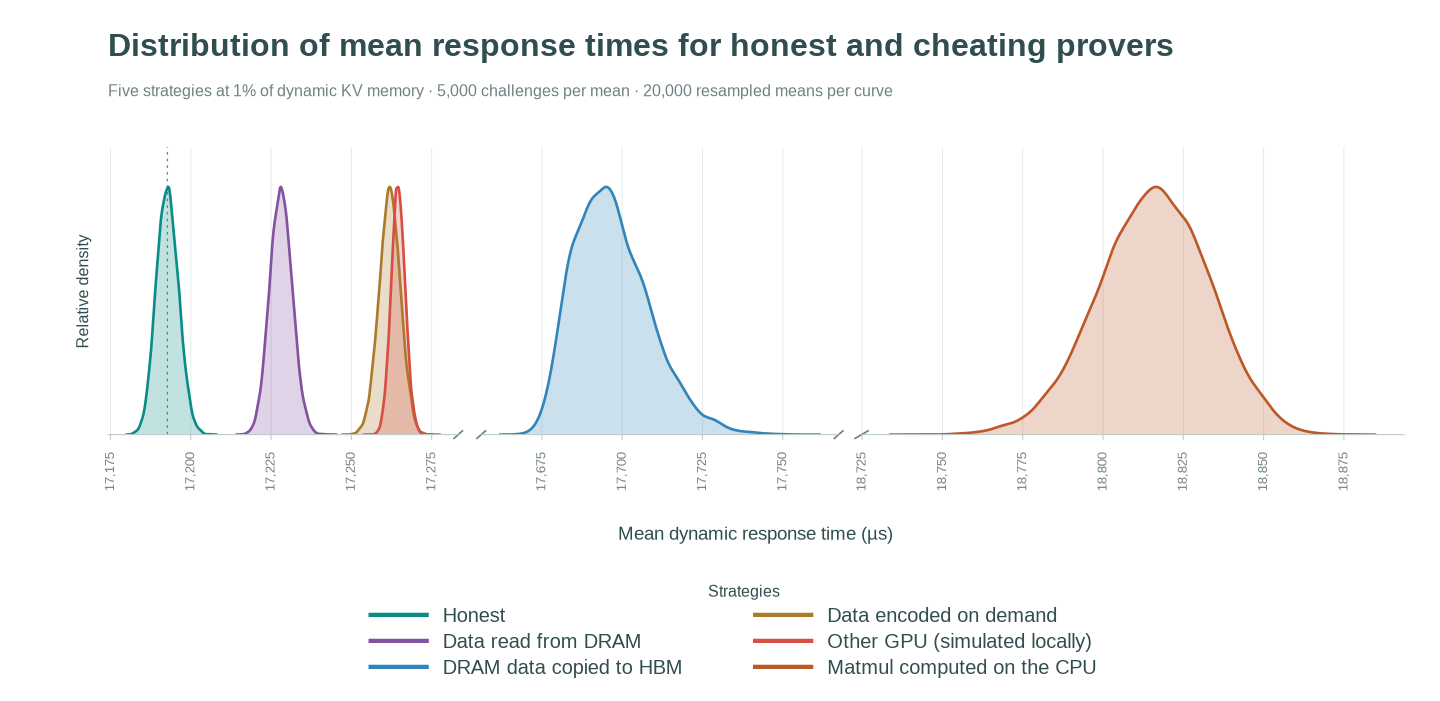
- Six conditions: honest, data read from DRAM by the GPU, data encoded on demand, another GPU simulated locally, DRAM data copied to HBM on demand, and matmul computed on the CPU. The other-GPU simulation used a differently encoded copy on the prover GPU and included no inter-GPU transfer.
- Each simulated strategy covered an aligned interval representing 1% of the challenged static blocks, located within the weights, and a separate 1% interval in the encoded KV region. The rest was answered honestly. Live KV writes and page resets refreshed the copies used by the dynamic simulators.
- Honest calibration at the measured load: 200 warm-up and 3,000 calibration challenges of each kind. Static and dynamic challenges were equally likely, with exponentially distributed waits averaging 62.5 ms before the next round.
- 23 rounds, each with all six conditions in a new random order. Each condition lasted 40 s per round, giving 92 minutes in total. The first 2 s after every switch were discarded.
- The analysis retained 25,972 static and 26,050 dynamic kernel-timestamped responses. The verifier sampled 2% for correctness. All 569 sampled static digests matched. It saved 578 dynamic records for offline replay.
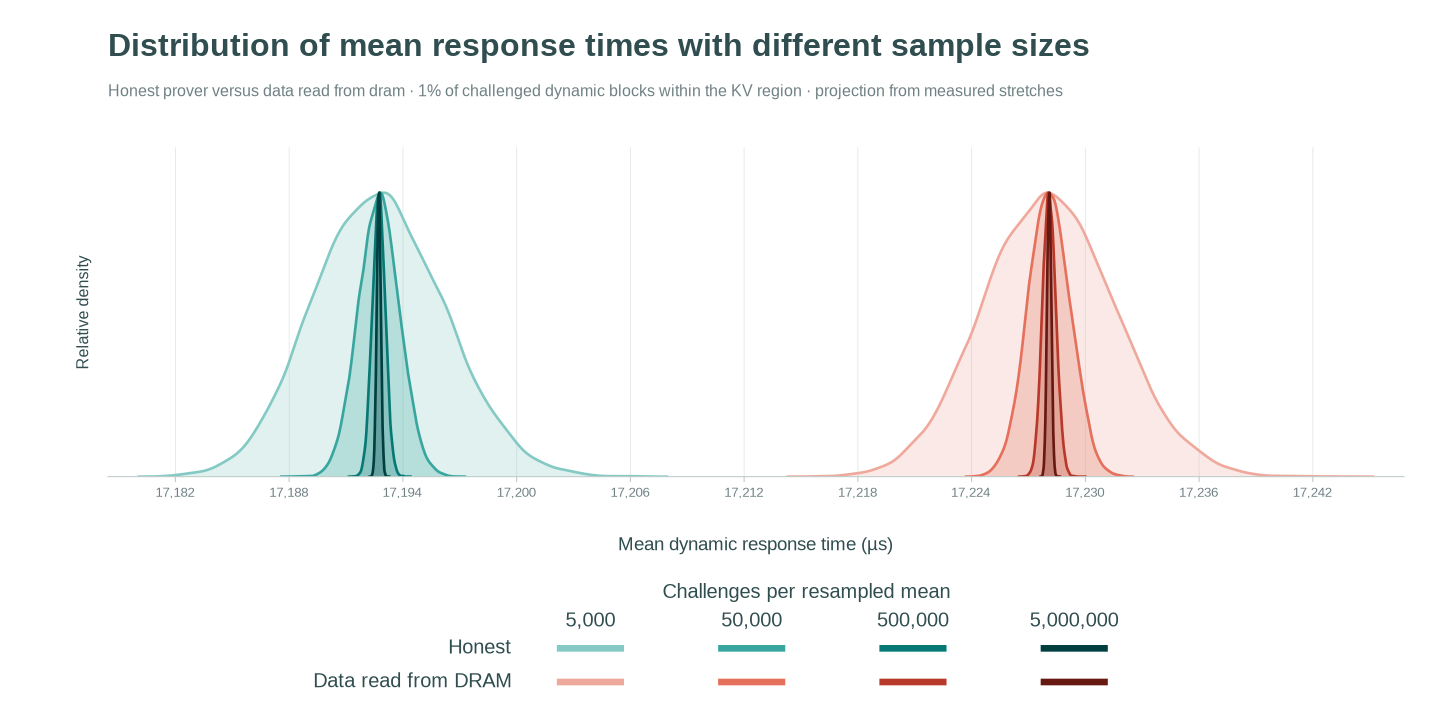
- For each curve, 20,000 resampled means. We sampled whole measured stretches with replacement and truncated the final stretch at the specified window length. The six-condition plots use 5,000 responses per mean. The sample-size comparison uses 5,000, 50,000, 500,000 and 5,000,000. The larger windows are projections from the same 23 stretches per condition. The 3,000-challenge calibration did not establish the formal 1% detection bound.
Performance analysis
- Five stages in separate vLLM processes: stock vLLM; deterministic inference settings; add encoded weights, layer-by-layer weight decoding and static filler; add activation and KV-cache encoding and decoding; add static and whole-pool dynamic challenges.
- Deterministic settings included batch-invariant kernels, eager execution and Triton attention, with prefix caching, chunked prefill and asynchronous scheduling disabled.
- 256 concurrent requests per call. Distinct 256-token prompts generated with seed 1 and exactly 256 generated tokens per request. Greedy decoding with end-of-sequence stopping disabled. One warm-up and three timed calls per stage. Throughput is total generated tokens divided by total elapsed time across the three timed calls, including prefill.
- Full stage: 86.79 GiB of challenged static memory and 45.34 GiB of challenged dynamic memory. Honest calibration at 256 requests, with 200 warm-up and 1,000 calibration challenges of each kind. The verifier selected challenge kinds in proportion to the challenged region sizes, with exponentially distributed waits averaging 250 ms.
- The prover answered 1,380 static and 704 dynamic challenges during the three timed calls. Full-stage throughput was 330.47 generated tokens/s, compared with 2,648.18 tokens/s for stock vLLM.
Unaccounted memory analysis
- Honest prover with 86.79 GiB of challenged static memory (64.56 GiB of encoded weights and 22.23 GiB of filler), and 45.34 GiB of challenged dynamic memory.
- Resting snapshot after allocating the encoded weights and filler, before exporting the verifier’s reference. We recorded free device memory, allocated and reserved PyTorch memory, and resident tensors. The scratch subtotal was 7.67 GiB.
- Honest calibration at 256 requests: 200 warm-up and 3,000 calibration challenges of each kind. Static and dynamic rounds were equally likely, with exponentially distributed waits averaging 125 ms.
- Three load phases: idle for at least 40 s, 16 concurrent requests for at least 40 s, and 256 concurrent requests for at least 70 s. Active requests used 256 prompt tokens, 48 generated tokens, temperature 0.8 and sampling seed 1. Batches ran to completion. Observed phase durations were 40.0, 53.5 and 130.1 s.
- Sampling: 2% of static digests checked and 8% of dynamic evidence saved. All 68 static digests sampled in the three measured phases matched. The memory run saved 322 dynamic records across the verifier run.
- Encoding allowance: 6.19 GiB under the verifier’s credit of 61 bits per 64 bits. The sampling allowance was 1% of the challenged memory, conditional on detecting a 1% deviation.
- The transfer estimates in the main table use the observed mean waits and round trips at 256 requests, multiplied by an assumed transfer rate of 50 GB/s. They estimate transfer capacity. The 18.60 GiB total follows the table’s additive convention and can count capacity in more than one challenge interval.
5 Assumptions List
Terms
-
Declared data: what the prover says is in each GPU’s HBM. This is the encoded weights (the static region) and, in the dynamic regions, the KV cache and activations that the declared inference state should produce.
-
Memory layout: the agreed map of each GPU’s HBM. Each region has a position, a size (or bounds on its size), what it holds, and how its content is checked.
-
Challenged memory: the regions of the layout that challenges read. The rest, such as system overhead, is unchallenged memory.
-
Deviating data: declared data that isn’t held, in its declared encoded form, at its declared place in the GPU’s own HBM at a given moment. For example, it may be held in DRAM, on another device, or in a compressed form, or be regenerated on demand.
-
Deviating fraction: the share of declared data that is deviating, averaged over a set of GPUs and a time T. It is measured in byte-seconds: deviating bytes × the time they deviate, over declared bytes × T. Equivalently, it is the chance that a block picked uniformly at random over the GPUs, the time T and the challenged memory is deviating.
-
Challenge: the verifier sends a random start position and nonce. The prover walks a chain of L reads, where each read’s address comes from the block before it, and returns a hash. The verifier times the round trip.
-
Δc: the least extra time that one read on deviating data costs, over every cheat in scope (Goal 2).
-
Honest baseline: the distribution of an honest prover’s response times. A response’s excess is its time minus the baseline mean.
-
Timing boundary: the hardware that could answer a challenge in time: the GPU, its host, and anything joined to them by a fast link such as NVLink.
Claims
Claim 1. If the deviating fraction over a set of GPUs and a time T is at least F, the prover passes the challenges over T with probability at most 1 − C. An honest prover is wrongly flagged with probability at most α.
Claim 1 is about where the data is, which the verifier can’t observe. Our implemented statistical timing test checks a narrower statement about response times, which it can measure:
Claim 2. Take the true mean excess response time to be the expected excess of one challenge. The expectation is over the verifier’s random choice of challenge (GPU, moment within T, start position) and over timing noise. If the true mean excess is at least F·L·Δc, the test passes with probability at most 1 − C. F·L·Δc is the least excess that a deviating fraction F adds to a chain of L reads.
Why Claim 2 implies Claim 1
The verifier samples challenges uniformly (Goal 3), so a chain of L reads lands on deviating data L·F times on average, however the cheating is arranged. Each of those reads adds at least Δc (Goal 2), and the extra times add up along the chain instead of overlapping (Goal 2.1). So a deviating fraction F gives a true mean excess of at least F·L·Δc, and a test that catches that excess catches the cheating.
This step isn’t yet written up as a formal proof. Data moved back into HBM during a challenge weakens it (Open question 5).
What the claims don’t cover
-
Which model it is. Memory accounting shows that the declared data is in memory. It doesn’t show that the declared model is the one that passed evaluations or came from a given training run. Verification that the model is correct needs a separate protocol.
-
Small changes. Single-bit flips, or changes to small parts of the data, are not detected efficiently. The scheme bounds the amount of undeclared data, for example the size of an adapter, not every change.
-
Unchallenged memory. Undeclared data can sit in unchallenged memory without being challenged. The claims therefore exclude only undeclared data larger than the unchallenged memory, whose size must be known and bounded (Assumption 3.1).
-
Where cheating would pay. The claims hold for the GPUs and the time T they name. These must cover every GPU and time span where the prover could gain from cheating.
-
Confidentiality. Claims 1 and 2 say nothing about it. In our PoC version the verifier sees the weights and the inference inputs and outputs (Assumption 3.5).
Assumptions
Assumption 1: The verifier is trustworthy, and out of the prover’s reach.
Every decision is the verifier’s: what is challenged, when, and whether a response passes. A verifier the prover can corrupt, predict or rush can pass any prover.
1.1: The verifier correctly executes its code.
A compromised or faulty verifier can pass any prover. This trust can be supported by:
-
a small verification stack with few dependencies, which may allow formal verification;
-
running it on hardware the prover doesn’t control;
-
independent verifiers run by separate parties.
1.2: The verifier’s clock and randomness are out of the prover’s reach.
Clock. The verifier times each round trip with a monotonic clock. Its resolution and stability are much finer than the timing margins, which are microseconds. The prover can’t read it, adjust it or predict its readings.
Randomness. Challenge times, start positions and nonces come from a cryptographically secure generator. Its seed comes from a source the prover can’t observe or influence, and no value is revealed before it is used.
If the prover could read, predict or influence either one, it could time its cheating around challenges or answer early.
1.3: Records are kept intact until they are checked.
Dynamic content is checked after the challenge. The challenges, responses and commitments must therefore be kept without loss or change until they are checked. Signed or hash-chained records, held by systems the prover doesn’t control, can support this.
Assumption 2: The verifier knows all the hardware that could answer a challenge.
The argument is about space and time on known hardware. Memory or compute the verifier doesn’t know about is room to hide data, or a faster way to answer.
2.1: The verifier knows the HBM capacity of each GPU precisely.
If every region of HBM is accounted for, there is no room for another model. If the real capacity is larger than the verifier believes, the excess is unaccounted space. With zero trust between the parties, this needs an independent source, such as published specifications or an inspection at setup.
2.2: The verifier knows every memory device and accelerator inside the timing boundary, and they don’t change after baselining.
Any memory or compute in the timing boundary that the verifier doesn’t know about can serve as fast storage or fast computation for a cheater. This covers custom accelerators, near-memory compute, and faster interconnects added after the baseline was measured. Hardware that produces responses faster than honest gives a cheater slack that timing can’t see.
2.3: No GPU inside the timing boundary goes unchallenged.
An idle or unchallenged peer GPU on a fast link is a store a cheater can read from much faster than DRAM. That would make the extra time per deviating read much smaller than the Δc the claim assumes.
Assumption 3: The verifier knows what each GPU’s memory should hold.
Deviating data is defined against the declared data. The declared data has to be fixed, checkable and reproducible by the verifier, not chosen by the prover as it goes.
3.1: The memory layout is agreed in advance, per model and hardware.
Both parties agree on the layout for each model and hardware combination before the prover starts serving. It lists every region: encoded weights, KV cache, activations, scratch, and unchallenged memory. Each entry gives the region’s position and size, with bounds for those that change in use. The layout is not declared by the prover on the fly. A prover that can choose the layout at each challenge can make a region larger than it needs and keep undeclared data in the difference.
The unchallenged memory must be known and bounded, because its size sets how much undeclared data the claims can’t exclude.
The current implementation still takes the dynamic region sizes from the prover at each challenge (Open question 4).
3.2: The commitment matches the declared data.
Each hash in the commitment equals the hash of the matching group of blocks. The blocks are the declared weights encoded under that GPU’s key. Everything after setup is checked against this commitment. The verifier must therefore check it by recomputing the encoding itself, or by a zero-knowledge proof (Assumption 3.5).
3.3: The weights in the commitment are the weights the parties registered.
This is needed only when the claim is about a specific model (see What the claims don’t cover). Without zero-knowledge proofs, the check is the recomputation in Assumption 3.2, started from the registered weights.
3.4: The verifier can reproduce the prover’s inference exactly.
This is needed only for the dynamic regions and the baseline. For the static weights alone, the verifier needs only the commitment and the layout. To recompute the KV cache and activations bit for bit, the verifier must know the model, inference engine, kernels, versions and configuration, and run them itself, on the same GPU type. The baseline must also be measured on the same stack (Assumption 4.1). A change to the stack is a new setup.
3.5: The verifier may see the weights and the inference inputs and outputs.
This is a current limit of the PoC, which zero-knowledge proofs would remove.
The verifier uses the weights to check the commitment (Assumption 3.2), and the inference inputs and outputs to recompute the dynamic contents (Assumption 3.4). This suits a lab checking its own deployment. It doesn’t suit an agreement between parties that don’t share their weights or users’ data.
A zero-knowledge proof could replace each check:
-
The commitment. A proof that the committed encoding was computed from weights whose hash matches a registered hash. The verifier would no longer need the weights.
-
The dynamic contents. A proof that they are what the declared model produces from the inputs. The verifier would no longer need the inputs and outputs.
The proof part makes the check sound without the verifier redoing it. The zero-knowledge part means the verifier learns nothing beyond the fact that the statement holds. The timed challenges themselves return only hashes. A proof for the commitment is a one-off computation at setup.
3.6: The prover pauses inference at a well-defined point when challenged.
See Open question 6.
3.7: The prover commits to the weights of all GPUs before it receives the seed.
This prevents a sealstack attack on the weights: the prover cannot choose weights that depend on the encoding keys. The PoC does not do this yet. We still assume that the prover cannot choose inference inputs that make the activations or KV cache equal to encoded data.
Assumption 4: The honest response time is known, and can’t be beaten.
Every timing decision compares a response with the honest baseline. Cheating is visible only as time above that baseline. Anything that makes the honest part of a response faster than the baseline gives a cheater slack to hide in. Anything that makes the baseline itself uncertain raises the amount of cheating that can be told apart from noise.
4.1: The honest baseline matches the prover’s honest response times in operation.
The baseline has to match how an honest prover responds in operation: the same hardware, inference stack, memory layout and network path. It also has to cover the fastest load, temperature and configuration the prover can choose. A baseline slower than what the prover can achieve leaves slack the prover can spend on cheating.
The baseline has to be measured on trusted hardware and software. If it is measured on the machine under test, a prover that cheats during calibration sets its own baseline.
4.2: The network path between verifier and prover is short and stable, and the prover can’t make it faster than at baselining.
The round trip includes the network. Jitter and drift on the path raise the number of challenges needed and the false-alarm rate, and a dedicated, quiet link in the same rack keeps both small. The prover can delay the path, which only hurts itself, but it must not be able to make it shorter than at baselining.
4.3: A cheater is never faster than an honest prover on the honest part of a response.
A prover that could speed up the honest part could use the gain to hide cheating, for example by idling other work during challenges. Assumptions 4.1 and 3.1 cover the main ways this could happen.
4.4: The honest level stays within a known, bounded drift of the baseline.
See Open question 1.
4.5: Response times are independent, or only weakly dependent.
See Open question 2.
4.6: For a claim over many GPUs, the honest level drifts independently on each GPU.
See Open question 3.
4.7: A deviating fraction F adds at least F·L·Δc to the mean response time.
This follows from Goal 2 (every deviating read costs at least Δc) and Goal 3 (the verifier samples uniformly). It is what connects the test to the claim about F. We haven’t formalised this step.
4.8: Clipping removes little of the time that cheating adds.
The test compares clipped means, and a response is capped at c = μref + L·Δc. When an already slow response also has cheated reads, the time above the cap isn’t counted. We assume this loss is small: honest responses go above μref by much less than L·Δc, and the prover can’t aim its cheating at the slow ones. An earlier run used L·Δc = 2,048 µs and measured an honest standard deviation of 28.7 µs per response. This isn’t yet proved.
4.9: Every challenge the verifier sends is counted.
The test mean is over all N challenges, and the baseline mean is over all B challenges. A late or missing response is recorded at the cap c. Otherwise a prover could lower its mean by not answering the challenges that land on deviating data.
4.10: vH is at least the true variance of a clipped honest response.
vH is chosen above the variance measured in the baseline, and the threshold t is calculated from it. The bound must hold during the test, not only during the baseline. If honest responses vary more than vH, the stated error rates don’t hold. The main effect is that an honest prover can be flagged more often than α.
4.11: The cap, the sample sizes and the threshold are fixed in advance.
The cap c is fixed before the baseline is collected. B, N and the threshold t are fixed before the test, and the test isn’t stopped early or extended because of the responses seen. Otherwise the stated error rates don’t hold.
4.12: The error rates are for one test window.
α and 1 − C apply to one test window of N challenges. Over m test windows, the probability of at least one false flag is at most m·α.
4.13: This test assumes no drift.
The analysis assumes that the honest clipped mean is the same in the baseline and in the test. Assumption 4.4 allows a bounded drift, but the threshold t has no term for it yet. A drift of h µs upward adds h to the honest mean difference, and a drift downward hides h of cheating. See Open question 1.
Design goals
Goal 1: The declared data can’t be held in less space, or rebuilt fast enough to answer.
This is the job of the incompressible encoding, and it is what lets timing say something about space. It makes each GPU’s copy of the weights unique and impossible to store in less space. It also makes each block slow to rebuild from anything smaller. A prover that wants to free HBM must then hold some blocks elsewhere, and pays Δc whenever a challenge reads one.
1.1: No representation of the encoded data that answers challenges in time is smaller than the data itself.
Any bits that are always predictable, for example always zero, are not counted as accounted space. In our encoding, 34 bits of every 128-byte row are always zero.
1.2: Encoded data can’t be rebuilt from a smaller form fast enough to answer in time.
Encoding a block on demand must cost at least Δc per read on the fastest hardware in the timing boundary. Each GPU’s copy must be encoded under its own key, so one stored copy can’t answer for two GPUs.
Goal 1.2 rests on the four assumptions below. In them, a word is the 90-bit value that the encoding works on.
1.2.1: One word has no shortcut.
We assume that a prover with no precomputed table can’t compute a square root modulo 2^89 − 1 faster than 87 squarings in series. Sloth makes this assumption for large primes and many rounds. We make it for an 89-bit prime and one round.
1.2.2: Many words have no shared shortcut.
We assume that encoding n words costs n times the cost of one word. The prover can encode words in parallel, but can’t share work between them, because each word has its own tweak.
1.2.3: A lookup table does not make Encode fast enough.
Encode calculates a square root modulo p = 289 − 1 with 87 squarings. A prover can replace the squarings with a lookup table. We assume that this does not make Encode on demand cheaper than Δc per read. This holds for a prover with x bytes of lookup tables in DRAM over a connection of y bytes per second, and z bytes of lookup tables in unchallenged HBM, where:
-
x has no limit.
-
y is at most 57.7 GB/s (our measured copy speed from DRAM). At this speed, one read of the block itself from DRAM is cheaper than the table reads for that block, and we measure that cheat.
-
z is too small to hold a useful part of the table. The smallest table that we know is 299 TB (272 TiB). We don’t know yet how much a part of the table helps.
We previously used . A compact lookup table of about 12.15 GB (11.3 GiB) could speed up root computation at that field size. This motivated the switch to the 89-bit field.
1.2.4: Our Encode is the fastest.
We assume that no implementation on the fastest hardware in the timing boundary encodes a block faster than ours
Goal 2: Every read on deviating data costs at least Δc extra.
This is what makes cheating visible as time. It covers data held in DRAM, on SSD or on a peer device, and data that is regenerated or decompressed.
2.1: The chain must be walked in order, one read at a time, using every block in full.
All the timing rests on this. The next address comes from a hash of the previous block, so a read can’t start until the one before it is done. The prover can’t fetch deviating data early or in parallel. As a result, the extra time of each deviating read adds up along the chain instead of overlapping.
For this to hold, the hash and compression functions must leave no shortcut. There can be no smaller precomputed table, and no way to compute a block’s contribution from less than the whole block.
2.2: The compute step in each read is only fast enough next to the GPU’s memory.
Hashing alone could be answered from DRAM almost as fast. Each read therefore includes a compute step, such as a matrix multiply, that is only fast enough when the data sits in memory attached to the GPU.
2.3: Displaced declared data is read from a slower tier when challenged.
If undeclared data occupies HBM, the declared data it displaced sits somewhere slower, and challenges that land on it are answered from there. A prover that doesn’t hold the declared data anywhere fails the content check outright.
2.4: Δc, measured over the cheats we know, bounds every cheat in scope.
Goals 1, 2.1, 2.2 and 2.3 are how the design tries to make every cheat cost time. We can only measure the cheats we know of. What remains assumed is that the least extra cost we measure, Δc, also holds for cheats we haven’t measured. A cheat cheaper than Δc per read would be under-counted by the claim.
Goal 3: The prover can’t predict which blocks a challenge will read, or when.
The verifier samples challenges uniformly over GPUs, time and challenged memory, from its own randomness (Assumption 1.2). Nothing about a challenge is revealed before its timed window starts. A notice that a challenge is coming may reveal only that one is coming, not what it will read. This is what lets the verifier catch concentrated cheating in proportion to its size, however the cheating is arranged.
Goal 4: Dynamic contents can be reproduced exactly from the declared state.
Recomputation must reproduce the dynamic contents bit for bit from the declared model and state, with no tolerance. We meet this the same way as elsewhere in our inference verification work: either an integer-exact model replayed on the verifier, or the inference engine in a batch-invariant mode, with the verifier on the same GPU type (Assumption 3.4). What state a challenge is checked against is Open question 6.
Open questions
Open question 1: How should we handle slow movement of the honest response time?
Assumption for now (Assumption 4.4): the honest response-time distribution stays the same between baseline and test, apart from a known, bounded drift.
The honest level moves over minutes and hours, for example with load and temperature. More challenges don’t average this movement away, because it is shared by all of them. An honest level above the baseline causes false alarms, and one below it hides cheating. The current test allows a fixed bound in both directions. In a 43-hour honest run the level moved between 0 and 12 µs below its start-up value. A baseline taken at start-up missed some bunched cheating that a baseline taken in steady state caught.
A fixed allowance may not be the best approach. Options include:
-
regular re-baselining;
-
a reference measurement interleaved with the challenges, so the test compares against a moving honest level;
-
a mathematical bound on how much a given drift can hide.
Open question 2: Are challenges close together correlated?
Assumption for now (Assumption 4.5): response times are independent, or only weakly dependent.
The statistical test assumes independent responses. Uniform sampling makes the cheated reads independent, but the honest times can be correlated through contention between challenges close together, thermal effects and load patterns. The test allows for this with a margin on the honest standard deviation. Short-range correlation between nearby challenges hasn’t been measured. This links to the question of how close together challenges can run.
Open question 3: Does slow movement of the honest level average out across a fleet?
Assumption for now (Assumption 4.6): slow movement of the honest level is independent across GPUs.
A fleet-wide claim averages the honest level’s movement over many GPUs and long times. This works only if GPUs don’t move together, for example with a shared room temperature or a shared load pattern. The baseline must also cover as many independent periods as the claim. Otherwise the smallest F that can be tested stays high, however many challenges are run. So far we have measured a single GPU.
Open question 4: How does the prover commit to its inference state?
Binding the reported inference state to the live request remains an open question.
A prover could keep undeclared data in a dynamic region, then claim to be idle when a challenge request arrives. There may be related attacks like this that we have yet to fully analyse.
Relatedly, Assumption 3.1 asks for the layout to be agreed in advance, per model and hardware. The current implementation instead takes the dynamic region sizes from the prover at each challenge. The KV cache in particular grows and shrinks with load. We still need to work out how tight a bound can be agreed in advance without breaking honest serving.
Open question 5: How much data can be moved back into HBM during a challenge?
Between receiving notice of a challenge and the end of its reads, the prover can move some data back into HBM. The amount is at most the notice time plus the challenge’s duration, multiplied by the fastest transfer bandwidth into HBM. Timing can’t see this, so it adds directly to the claim: F_total ≤ F + (data reloadable during a challenge) / (HBM capacity).
In an earlier hardware test, copies from pinned DRAM reached 57.7 GB/s (PCIe 5 x16). An 8-read challenge lasts about 1.1 ms, so about 63 MB, 0.08% of the 76 GiB of static weights, can be reloaded during one. Longer challenges allow more. In simulation, with copies at that speed, the smallest share caught stops falling at about 1.4% from about 128 reads (17 ms), instead of continuing to fall. This argues for making each read faster rather than adding more reads.
Open question 6: How does the verifier pin down what the dynamic regions should hold at a challenge?
Assumption for now (Assumption 3.6): the prover pauses inference at a well-defined point when challenged.
The dynamic regions change many times a second. The verifier can only say what they should hold at a point it can identify, such as a step or layer boundary. Without one, there is nothing to recompute against, and data in the dynamic regions can’t be checked as it may be challenged in an unrepresentative state. Pausing gives such a point, but it interrupts serving and the prover chooses where it stops. Open question 4 asks how the prover commits to that state.
6 Dynamic Results
Footnotes
-
To prevent the SealStack attack on the incompressible encoding, the prover must commit to the weights of all GPUs before it receives the seed. ↩
-
Each 128-byte row has 34 fixed zero bits. The verifier credits 61 bits per 64-bit word, which leaves 6.19 GiB of the 132.13 GiB challenged in the memory experiment unaccounted under the encoding allowance. ↩
-
Or the time it takes to encode all of the data in HBM. ↩