
The UK’s Advanced Research+Invention Agency (ARIA) and Renaissance Philanthropy (RenPhil) just announced a new genre of research institutes — Frontier Research Contractors (FRCs), but what are they, and why do people keep saying Amodo is one?
An FRC is an organisation that uses contracts and grants to fund technical research. FRCs primarily work on other people’s technical problems. They’re customer-focused, with excellent operational and delivery capabilities.
Many of the biggest R&D successes of the 20th century were won by research groups that we’d consider FRCs:
- ARPANET was run by Bolt, Baranek, and Newman (BBN)
- SR-71 was delivered by Lockheed Martin’s Skunk Works
Without these fit-for-purpose R&D groups, these breakthroughs could not have happened. No two FRCs are the same; the rest of this post explains ambitious FRC goals that Amodo has. There are three phrases that I use to capture Amodo’s FRC ambitions:
- Everyone needs their performer
- Shaping rather than reacting to contracts
- Using consultancy as a model for DeepTech venture creation
1. Everyone needs their performer
Performers are the R&D groups that work on DARPA contracts. A few well-known examples would be SRI, Raytheon BBN, and Draper Labs.
ARIA has no lab benches nor any research scientists; they only achieve scientific and technological progress by funding others to run research projects. This means that the success of ARIA is based on the success of the people and organisations they give their money to.
Anyone who wants to fund a research programme needs to find their “performers”, or “Creators”, to enact their vision. FRCs are organisations designed for this task. They are customer-focused R&D organisations whose scientists and engineers work on someone else’s vision. Whilst FRCs have their own view of what the future should look like (as discussed later), they are ultimately contractors. FRCs are different to startups, universities, and FROs because:
- Startups are focused on their product rather than running R&D that is driven by a funder’s requirements. On occasions, product market fit and funder requirements line up, but more often than not, working under contract is a distraction for a startup.
- Universities aren’t set up to be customer-focused. They struggle with operational delivery and rarely have highly integrated science or engineering teams.
- FROs are designed for highly coordinated multi-year projects. FRCs tend to work on smaller projects with shorter delivery dates.
It was BBN who built ARPANET, Skunk Works who built the SR-71, and Moderna (startup, not FRC!) who made the mRNA vaccine. As a funder wanting to make technical progress, you need institutions to fund. These will often be startups, universities, and FROs, but when the ecosystem doesn’t have an organisation that suits your requirements, that’s when you need a fit-for-purpose FRC.
EIC
If you browse EIC and EU HERA’s grants database you’ll come across dozens of examples of grant funds not given out. Two rounds that we’ve been tracking are on respiratory PPE and pathogen decontamination. Together the public announcements said they’d give out ~EUR 80M but as far as we can tell from public information they only found ~EUR 10M of promising opportunities.
EIC Accelerator Challenge: Aerosol and surface decontamination for pandemic management | Available funding: ~EUR 65M | Granted: EUR 1.8M (<3% distributed)
Call for proposals for next-generation respiratory protection (HERA) | Available funding: ~EUR 20M | Granted: ~EUR 8.5M (~45% distributed)
I’m pleased that the funders choose not to give money out over wasting it. But to convert capital into scientific progress funders need to spend time cultivating their performer.
Whose performer is Amodo?
We are the engineering team for leading science research groups.
“Progress in science depends on new techniques, new discoveries, and new ideas, probably in that order.” Sydney Brenner.
To develop new techniques, you often need new engineering. In the 20th century, scientists had access to engineers, but 21st-century research groups often have to choose between shoehorning their work into off-the-shelf hardware or giving up on promising research for a lack of suitable equipment.
Our engineers partner with scientists to solve their bottlenecks.
Our first-of-a-kind partnership with ARIA sees ARIA’s Creators (grantees) get access to our engineering team. We’ve developed equipment for four of the world’s top ten universities, have supported every one of ARIA’s programmes, and have expanded our “engineering enables science” model to other funders.
We are the def/acc performer.
Biosecurity, AI safety, and AI security are critical challenges that aren’t solved by existing markets — they all require fit-for-purpose performers.
There are very few groups set up to work on problems like “physical sciences for pandemic defence”. Academia can’t do highly coordinated engineering work, pandemic markets are unreliable, warding off startups, and existing engineering primes are unable to work on such uncertain and risky projects.
Through 2025, philanthropists and governments have become interested in funding the R&D required to prevent catastrophic pandemics and dangerous AI outcomes. We have stepped up to the plate as their performer.
In true BBN style, we started by writing a strategy piece with RAND (Physical Approaches to Civilian Biodefense) and off the back of this started a multi-year R&D programme to solve these problems.
2. Shaping rather than reacting to contracts
FRCs respond to a funder’s needs, but this doesn’t mean they are simply a drone working on someone else’s technical vision. The best FRCs don’t just respond, but shape what funders fund. In the middle of the last century, labs like BBN and Skunk Works both had employees going back and forth between funder and contractor, and held a position of esteem with the funders such that their ideas could turn into funding programmes.
BBN — Selling the digital computer
In 1957, young researcher J.C.R. Licklider went about persuading BBN leadership to invest in a state-of-the-art digital computer. When asked what he would do with it, he replied:
“I don’t know, but if BBN is going to be an important company in the future, it must be in computers.”
Two digital computers later, and BBN had to head out to find contracts:
“Then Lick and I took off for Washington, D.C., to seek research contracts that would make use of this machine […] Our visits to the Department of Education, National Institutes of Health, National Science Foundation, NASA, and the Department of Defense proved Lick’s convictions correct, and we soon secured several important contracts.”
Licklider had a vision for the future, BBN backed him, and they shaped what the funders were interested in in order to fund the work.
BBN — PDP-1d Time-Sharing: Hospital System
Another computing technology BBN was keen to pioneer was time-sharing. Here, they shaped NIH almost by accident:
“At night, he would go over to the home of Jack Masur, director of the NIH Clinical Center, where Masur would provide Baruch with gin and jelly beans. […] Baruch described his vision about the possibilities for patient medical records and various other interconnections, while Masur fed him more gin. The next week, after the speech, Masur phoned Baruch and told him the speech had been a hit— everyone was enthusiastic. Then he said to Baruch, ‘You should go do it.’ Baruch said that building this kind of system would be expensive. Masur told him to apply for a grant in the Division of General Medicine. BBN got the grant— $1 million over three years, Baruch remembers.”
BBN — Libraries of the future
In the 1960s, BBN took a project from the Ford Foundation to write about the “Libraries of the Future”. Eric Gilliam makes the point that BBN didn’t just fulfil this contract, but used it as the basis of further research they wanted to run.
“Going above and beyond what the Council on Library Resources likely expected, Licklider’s team used this contract as an excuse to explore seemingly futurist technology. For example, Licklider and the project team dedicated much of the second half of the report to technical explorations under the assumption that future library-goers might interact with the library as a store of knowledge with a question-answering front end, rather than as a means to check out books.”
In addition to shaping what funders fund, FRCs can use these projects as a launchpad or excuse to run research they wanted to anyway. FRCs must still deliver what the client wants — but contracts can be an opportunity to develop new tools or run the underlying R&D they wanted to do anyway.
BBN had a vision for what computing and networking would become and found the contracts and grants to fund the R&D they wanted to do. Most funding is no longer decided over gin and jelly beans, but there are still ways to shape what funders prioritise. At the end of the day, almost all funders care about turning capital into some form of scientific or technical progress. This means that, if you have a vision for how this can be done, more often than not, they’ll be excited to hear about your vision.
In 2024, we convinced ARIA that we’d be a great Activation Partner. The Activation Partners programme was designed to build the UK’s “science entrepreneurial ecosystem”. Reading their call for proposals, you can see they were looking to fund accelerator programmes, support spinouts, and set up new research organisations. We didn’t fit into these buckets, but we did believe we’d identified a bottleneck in UK R&D and thought that we had a solution for it, so that’s what we pitched them.
Amodo — ARIA Activation Partners
In May 2024, I met Ilan Gur (ARIA’s inaugural CEO) at a Royal Academy of Engineering event. He patiently listened to what Amodo worked on, and at the end of our conversation, said: “You should apply to Activation Partners, you won’t get it, but you should apply anyway so you’re on our system”.
We looked at their call and decided they’d missed what we deemed the biggest UK science and tech bottleneck — the lack of engineers working with scientists.
We spent weeks refining our proposal, a dozen friends reviewed our two-pager before it went to ARIA, and even then, we thought it was a shot in the dark. Having agonised over every word, we succeeded in persuading ARIA that we had identified a real constraint that might stop ARIA from fulfilling its mission. Like BBN, we pitched to the funder that their initial conception of the problem wasn’t correct, and that we had a different vision of the future that they should fund.
Our hypothesis has been validated, we’re expanding our partnership with ARIA, and copying this model to funders beyond ARIA.
P.S. If you want a way to accelerate the science you’re funding, then reach out.
3. Using consultancy as a model for DeepTech VC
Before I started Amodo, I firmly believed that consultancies were leeches and that only product companies were cool. We decided to start a consultancy because we believed it would help us to identify a product problem that we wanted to work on.
I no longer believe that consultancies are leeches, but I still believe that consultancy is a fantastic model for DeepTech venture creation because:
- You get up to speed with dozens of industries, which allows you to pattern-match across sectors
- Your team sees the whole product cycle through over and over again — training them to be fantastic product engineers
- In many cases, you are paid to solve real customer problems — validating market demand
By immersing our team in customer problems, we are building up a bank of product ideas that we can turn into spinouts.
This isn’t a new idea; in the previous century, contracting was an important way that companies were formed. This is best illustrated by the story of two Cambridges — Cambridge, Massachusetts and Cambridge, UK.
The MIT Technology Plan and its alumni’s companies
I first learnt about the MIT Technology Plan when supporting Eric Gilliam’s UK Day One proposal. Most of this is taken from that essay.
In the 1920s, MIT was on the verge of bankruptcy, and it decided to double down on its commitment to prioritise industrial customers, creating the MIT Technology Plan. This plan made MIT’s staff and facilities available to local industry for contract research.
The Technology Plan was a huge success on multiple fronts. Not only did it bring in revenue for MIT, turning it into one of the world’s leading technical universities, but it also led to the creation of a whole generation of successful technical firms. Pairing technical talent with industrial problems meant a proliferation of new firms. The firms that grew out of MIT affiliates in this period include Texas Instruments, Gillette, Raytheon, Arthur D. Little’s chemical consultancy, Koch Industries, McDonnell Douglas, and Rockwell International.
Cambridge Consultants — 27 spinouts and 4 unicorns
Cambridge Consultants has 1000 employees and does GBP 100m in revenue per year. Now focused on corporate projects under Capgemini, CCL actually has a fantastic startup history. Dig around online and you’ll find the claim that they have spun out 27 companies, including 4 unicorns (though I’m fairly sure this is wrong!!).
Cambridge Consultants is upstream of most startups and consultancies in Cambridge:
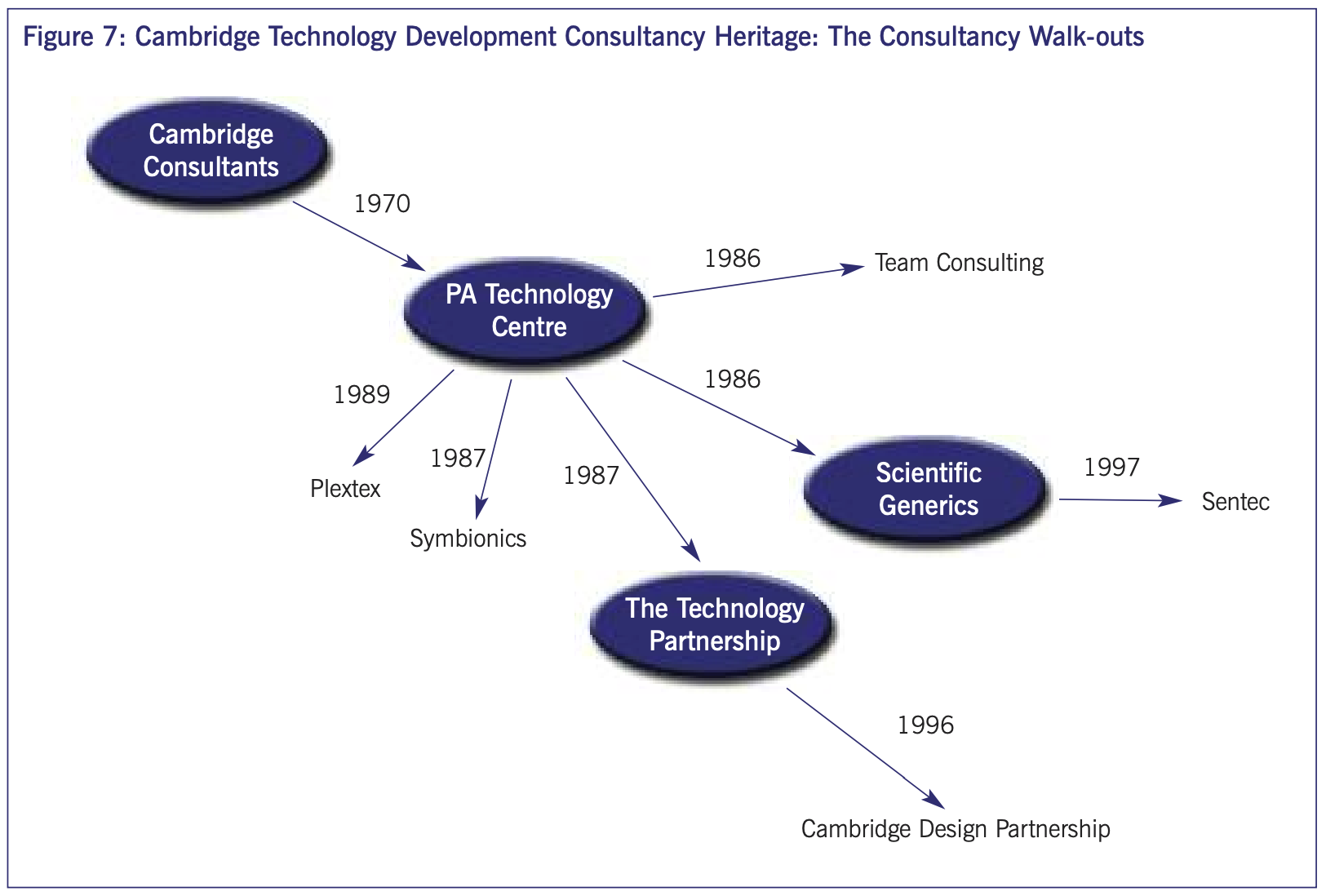 Cambridge Consultants family tree.
If you want to get a feel for the energy at CCL in the 1970s, then hunt down a copy of “From Ram Yard to Milton Hilton”.
Cambridge Consultants built a whole cluster, and there’s no reason that the FRCs can’t do that too.
The 21st Century’s FRCs
In 2025, ARIA and RenPhil set up the “FRC launchpad”. Whilst many of the groups funded aren’t new, this will be the first time a programme has framed R&D groups in this way. We’re excited to track their progress and see people try different approaches to funding science and tech.
FRCs are an essential part of tackling neglected technical challenges. When there is no existing market nor an established academic field, there is no one to solve technical challenges. As funders uncover important new avenues for progress, they should consider how to seed their fit-for-purpose performers.
Whilst we tend not to consider ourselves an FRC, we will nonetheless continue to expand our engineering contracting work. We now work directly with four funders, support four of the world’s top ten universities, and have dozens of engineering projects running at any one time. We’re fully bootstrapped, a team of more than thirty, and continuing to find ways for our engineers to accelerate technological progress.
If you’re a funder on the lookout for fit-for-purpose performers or a founder wanting to start an FRC, please reach out.