
Blog ai-security
The world's first government demonstration of AI compute verification
Amodo and the Dutch government ran the first AI verification experiment on government compute.
Contents
In September 2026, Dutch Prime Minister Rob Jetten presented a research agenda for AI Compute Verification at a UN General Assembly event. Following this first public international discussion on AI verification, the Dutch government have been the first government to run a public test of an AI Verification system on government-run compute.

Technical tools that enable coordination over AI development are often called “AI verification technologies”. AI verification technologies enable us to make claims about AI development and deployment provable, rather than trusting assertions and documentation.
What was the experiment?
When we talk about AI verification, we refer to a prover running a system and a verifier who is checking that the system meets an agreed specification or set of rules. In this setup, the Dutch government worked as the prover and Amodo as the verifier.
The rule being checked was that “this cluster may only serve Qwen 2.5 7B”. This is a specific operationalisation of a few different objectives that companies and governments may have:
- Specific data centres are only being used for inference and not training. → This system does that by checking that all packets are consistent with an inference, not training, workload.
- Only models approved (e.g. following the White House’s framework) can be served. → This system can check that tokens come from a specific approved model.
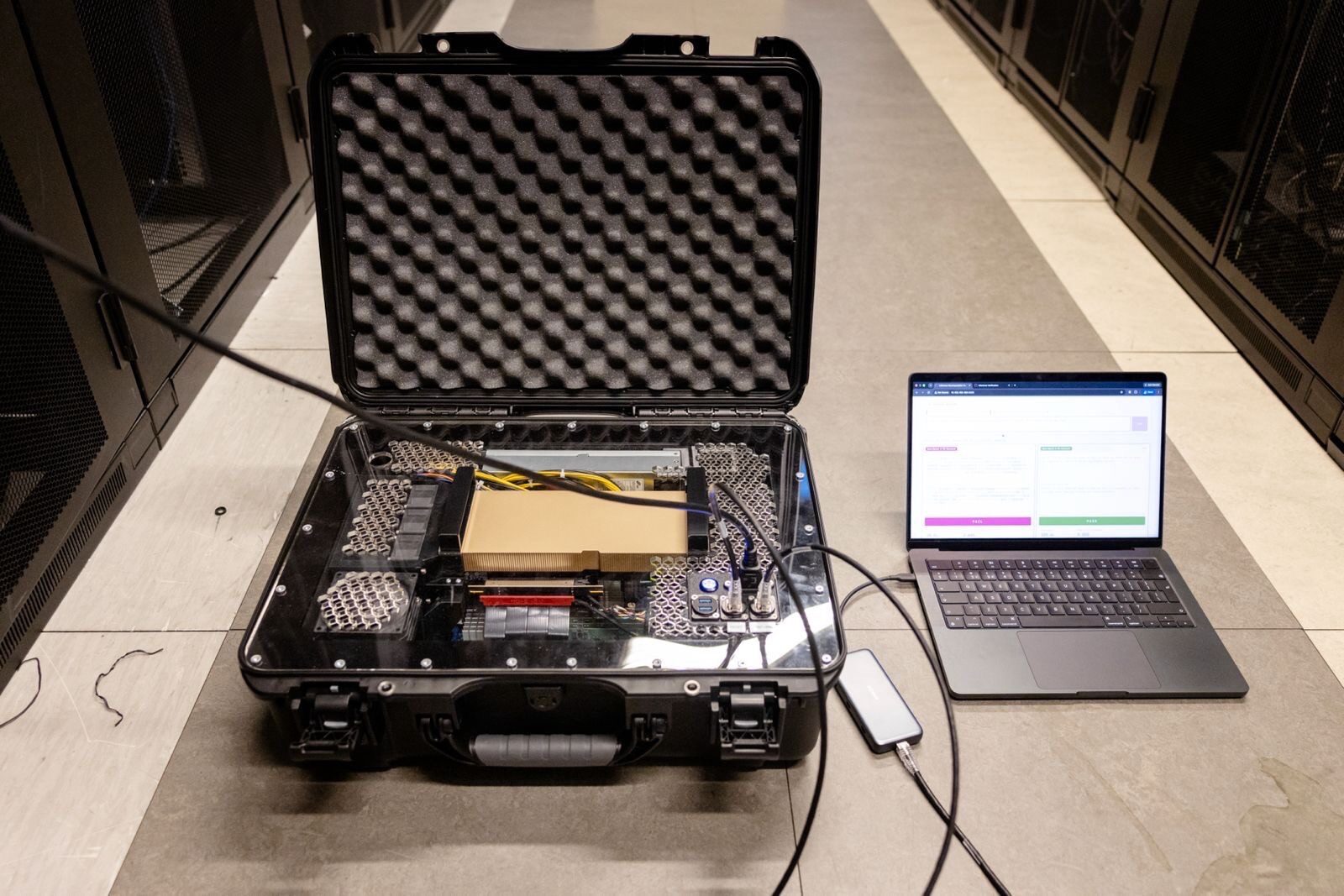
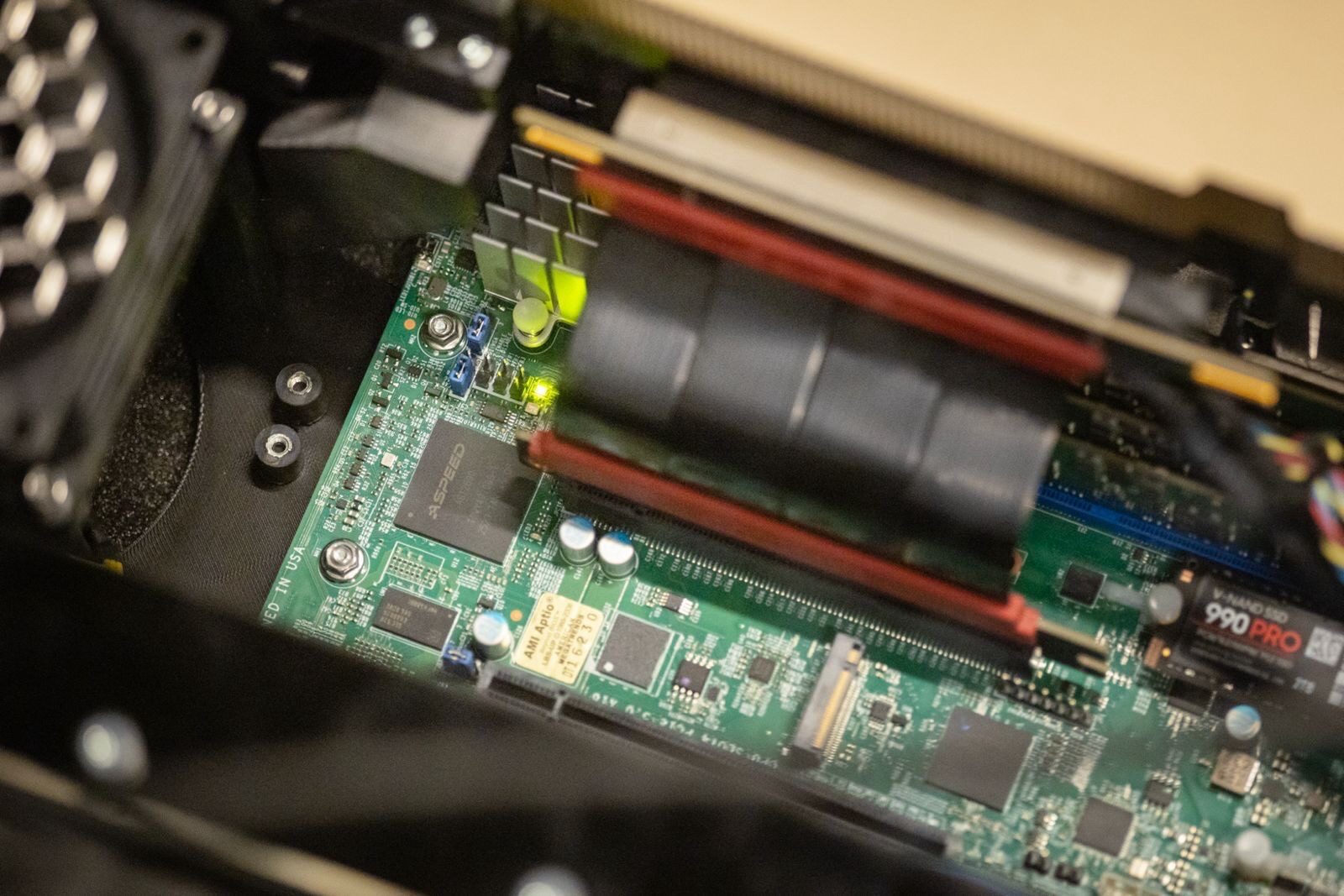
On 27th October, an Amodo engineer arrived at a Dutch government test lab in The Hague with an inference verification (recomputation) processor. Under the supervision of the SSC-ICT, Amodo installed the recomputation hardware. This processor receives network packets from the NVIDIA GPU server being run by the Dutch government. In this early experiment, the packets were forwarded using a prover-controlled network switch. In future instantiations, this system will use a mutually trusted network certifier, reducing the risk that the prover is able to cheat, whilst keeping its information confidential.
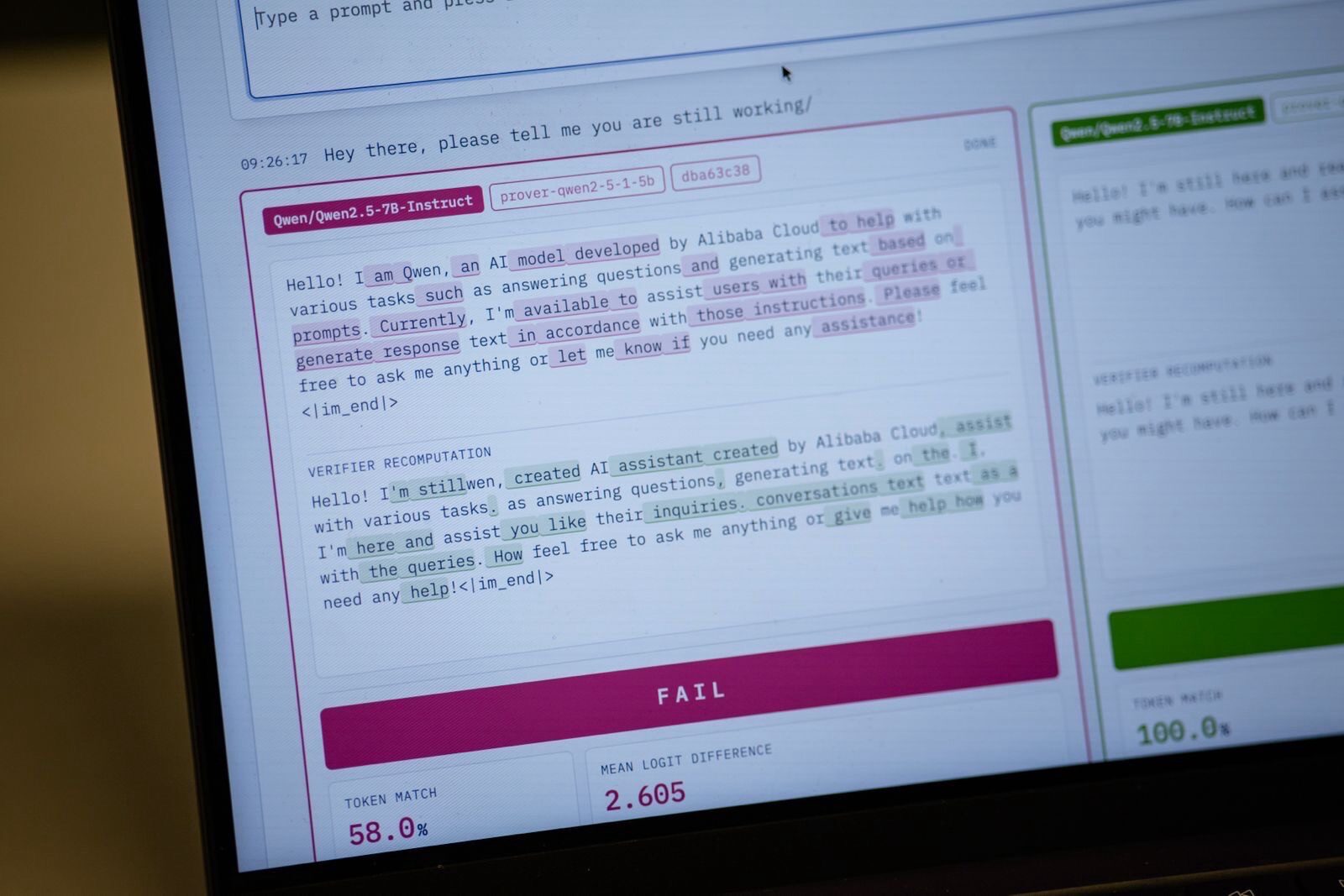
- As part of the experiment, the prover ran both the approved model (Qwen 2.5 7B), and an “illegal” model, Qwen 2.5 1.5B.
- The demo allowed users to send prompts to both models and see where the verification system flagged “allowed” and “illegal” model responses.
What is next for this work?
This experiment showed the principles of a simple AI verification system, but there is a lot more work to do to make this both mutually trustable and adversarially robust. The two important next steps are:
- Running verification using Zero-Knowledge Proofs. To preserve the confidentiality of the prover’s IP, verification systems should aim to use zero-knowledge proofs, cryptographic systems that prove the inference without revealing any IP. Amodo already has an early demo of this, and other research groups have advanced systems (e.g. Attestable).
- Building a mutually trusted network certifier. Should AI verification require hardware to be installed in the prover’s cluster, it will need to be both trusted by the prover and hardened against tampering by the prover. Both Amodo and FLI are working on formally verified and open-source network certifiers.
In addition to work to extend this verification system, there are lots of other promising research directions: software-only verification (ZKPs), verification using analogue sensors, memory and process accounting. Amodo is not alone in working on these technologies; startups and non-profits in the US, Europe, and Singapore (Lucid Computing, Attestable, SASH, GPAI, FLI) are all working on AI verification R&D.
Future experiments
As AI verification systems develop, so too does their testing. Startups, non-profits, and governments developing these tools need access to larger clusters and nation-state-level red-teaming to test the suitability of the technologies developed.
In the summer of 1988, the US and Soviet Union ran the “Joint Verification Experiment”. Adversaries worked together to test whether their verification tools could detect one another’s nuclear tests. To build trust, AI verification tools will need to undergo similar Joint Verification Experiments, both between governments and between companies.

Quotes
State Secretary Willemijn Aerdts (Digital Economy and Sovereignty, D66) calls it a “world first” in the field of AI. Not in the frontier labs of American tech companies or their Chinese counterparts, but in a government office on the Koningskade in The Hague. It is repeatedly emphasized that a special experiment is taking place here, on this Wednesday afternoon in late October.
A system capable of monitoring artificial intelligence is shown. This makes it possible to “supervise what is happening in large data centers,” according to Aerdts.
— Excerpt from Hugo Schiffers, NRC, 5 November 2026 (translated from Dutch)
Why is today’s demonstration a first? “It is the first time that this type of ‘hardware verification’ is being tested on a government server,” says Wouter Jurgens, Director of International Security Policy at the Ministry of Foreign Affairs, who also came to observe the experiment.
Previously, the technology was only tested on Amodo’s own systems. “You can understand that governments are generally quite reluctant to act as guinea pigs for new equipment,” says Jurgens. “But that shows how urgent the situation is.”
— Excerpt from Hugo Schiffers, NRC, 5 November 2026 (translated from Dutch)
“This first AI verification experiment run on government compute marks the start of an important and ambitious project to verify AI development and deployment. We cannot develop these technologies alone; government partnerships, like this one with the Dutch government, are essential to making sure AI verification succeeds.”
— Thomas Milton, CEO, Amodo Design